
Before planning a Southwest flight with your dog or cat, check where the airline permits ordinary pets to travel. American Service Animals (ASA) explains the route restrictions, carrier questions and reservation steps to review, while keeping trained service-dog accommodations separate from pet rules and emotional support status.
A convenient departure time is only useful if the whole itinerary works for your animal. Start with the destination, test the carrier at home, and confirm pet space before committing to the rest of the trip.
Southwest routes: domestic, Hawaii and international checks
Southwest accepts eligible cabin pets on domestic routes, with important exceptions. Ordinary pets cannot travel between the mainland and Hawaii, or on an itinerary containing an international flight. Travel between Hawaiian islands is treated differently: pets are accepted there, subject to the applicable requirements. Southwest explains these distinctions in its destination guidance for pets.
Check every flight, including the journey home. For example, a mainland departure followed by a connection to an international destination does not become an eligible pet itinerary because the first flight is domestic. Likewise, permission to take a pet between two Hawaiian islands does not establish permission to bring that pet from the mainland.
Write down your airports, connection points and operating airlines before asking about availability. Ask specifically about Puerto Rico or another territory rather than assuming every domestic destination has identical animal-entry requirements. If the route does not work, compare a different airline by route and carrier before purchasing a replacement ticket.
Animal age, carrier fit and two-pet checks
The Southwest pet policy covers small, vaccinated domestic dogs and cats aged at least eight weeks. Each ticketed traveler may bring one carrier containing up to two small animals of the same species. Southwest does not carry pets in the aircraft's cargo compartment.
Southwest's current carrier guidance lists a maximum of 18 inches long, 10.5 inches wide and 10 inches high for other pet carriers. Its own carrier is listed separately at 15 by 10 by 10 inches. The carrier needs ventilation, a leakproof base and enough room for the animal to stand and move comfortably. Southwest recommends a soft carrier and warns that available under-seat space varies, including at aisle seats.
Check the outside measurements and the usable space inside. A bag can satisfy an exterior limit while leaving too little room for the particular animal. Test the actual carrier with its normal bedding and both animals, if applicable. Do not assume that a seller's “airline approved” label settles whether Southwest will accept it.

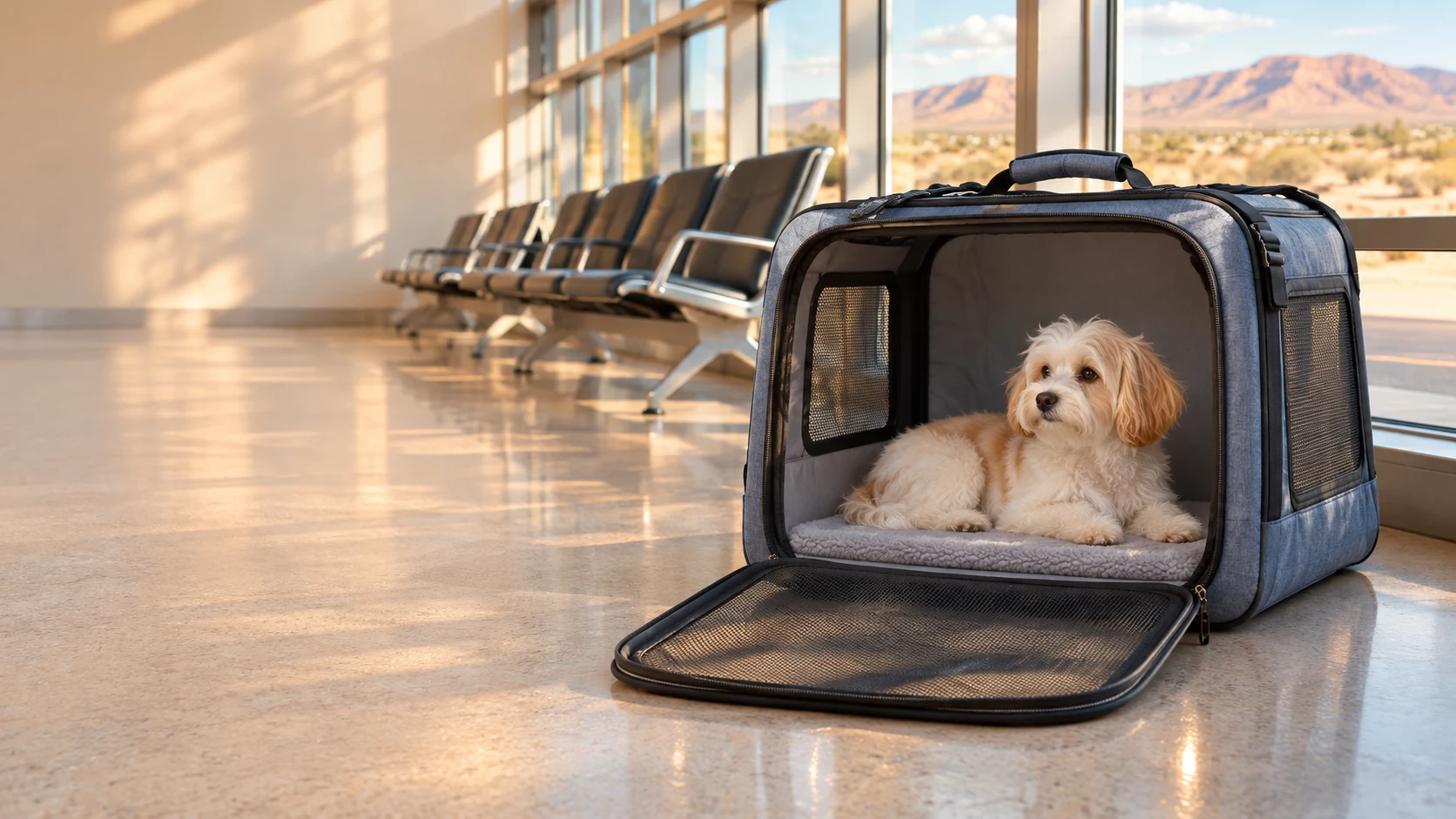
Original ASA editorial illustration of travel preparation; it does not demonstrate airline acceptance.
Reserving pet space and confirming the current fare
Contact Southwest to reserve pet space; its pet page says that pet reservations cannot be completed online. Capacity is limited, so a passenger ticket alone is not confirmation for your animal. The pet fare is paid at the airport ticket counter using an accepted credit card, and Southwest says it is refundable if you cancel your reservation. Confirm how that refund applies to your booking.
Southwest's Optional Travel Charges page lists the following one-way charges per carrier:
| Eligible travel | Published pet charge |
|---|---|
| U.S. mainland | $125 per carrier |
| Between Hawaiian islands | $35 per carrier |
At those listed rates, a straightforward mainland round trip would have $250 in pet charges, before the passenger fare and other extras. Confirm the amount for your actual itinerary, especially after a flight change. Save the pet reservation details alongside your own confirmation rather than relying on a note in your calendar.
Current seating choices for a traveler with an animal
Plan around Southwest's current assigned-seating system. When you can choose a seat depends on the fare and applicable benefits; the seat-selection guidance explains the options. Old advice about choosing any available seat after boarding is not a reliable plan for this trip.
For an ordinary pet, avoid an exit-row seat or a location without storage underneath the seat ahead. Those restrictions appear in Southwest's current Contract of Carriage. A more expensive seat is not automatically a better carrier location.
When discussing a seat, give the airline your carrier's measurements rather than asking only for “more room.” If your flight or aircraft changes, revisit both the seat and the pet reservation. Build that check into your travel plan instead of discovering a mismatch while boarding.
Check-in and onboard carrier planning
Allow time for the ticket-counter stop, screening and a relief break before boarding. Southwest's airport instructions say the empty carrier is screened while you hold your animal. Once in the gate area, keep the entire pet secured inside its carrier through boarding, the flight and deplaning. Follow the staff's directions at the checkpoint.
The carrier uses either your carry-on or personal-item allowance. Southwest permits the carrier with one personal item or with a regular carry-on; it is not an extra third cabin item. Review its cabin-baggage policy while packing, particularly if you also have a laptop bag or pet supplies.
- Keep the pet confirmation and required animal documents easy to reach.
- Check the airport map for a relief area before setting off.
- Pack cleanup supplies where you can find them without emptying your luggage.
- Leave enough time to return to the gate; a relief stop does not extend boarding.
Southwest ESAs and trained service dogs: different processes
Emotional support status does not place an animal in Southwest's service-dog category. The airline accepts dogs trained to perform disability-related work or tasks; ESAs and dogs still in training may qualify through the ordinary pet process instead. The service-dog instructions require the DOT air-transport form and describe presentation, control and seating requirements. A vest or registration does not replace that form.
Our guides to planning a flight with an emotional support dog and service-dog air travel protections explain the distinction in more depth. The questions about ESA and PSD assessments cover ASA's general assessment context, rather than airline reservation decisions.
If you want to explore your individual support needs, ASA provides a starting point for professional evaluation where available. A clinician decides whether documentation is appropriate. Completing intake does not guarantee a letter, create task training or make a restricted pet itinerary available.

Find out if an ESA letter is right for you
A few guided questions. Your personal details come last.
For ASA application support before your trip, contact our team. Pet availability, fares and flight changes need to be handled with Southwest.
Southwest pet travel questions
Can a pet travel between Hawaii and the U.S. mainland on Southwest?
No, the ordinary-pet policy excludes that itinerary. Do not buy a mainland-to-Hawaii ticket assuming an interisland pet allowance applies. Qualified service-dog travel has a separate process, and destination-entry requirements still need attention.
Are pets allowed on Southwest flights between Hawaiian islands?
Yes, Southwest distinguishes interisland travel from mainland-to-Hawaii travel. Confirm space for the particular flight and check the relevant Hawaii procedures before booking. The published interisland charge is $35 one way per carrier.
Does Southwest accept ordinary pets on international itineraries?
No. The restriction covers an itinerary that includes an international flight, not only the final international leg. Review the entire booking before choosing Southwest for a pet trip.
Can two pets share a carrier on Southwest?
Up to two small cats or two small dogs may share the traveler's single carrier. Both animals must fit comfortably within an acceptable carrier; sharing is not a way to squeeze an unsuitable pair into a smaller space.
How should I choose a Southwest seat when traveling with an animal?
Use the current seat map and tell Southwest whether you are traveling with a pet or a trained service dog. For a pet, choose a location compatible with under-seat storage and the carrier. Recheck the arrangement after any itinerary change.
Does a Southwest ESA booking use the service-dog process?
ESA status alone does not qualify an animal for that process. Start with the pet rules unless the dog actually meets the disability-related training requirements. Clinical documentation and airline accommodation paperwork serve different purposes.
