
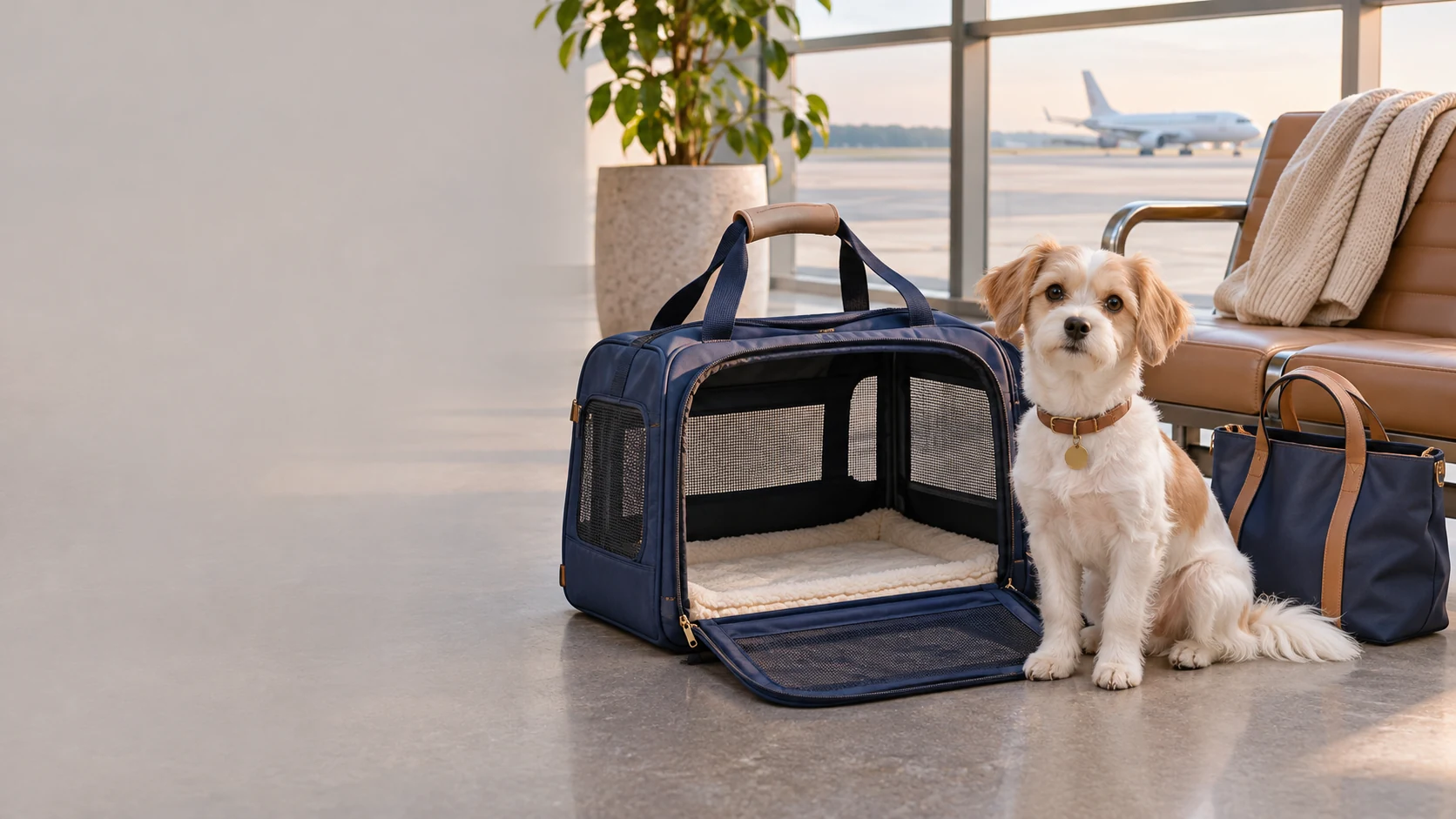
Yes, an emotional support dog may be able to fly, but the booking category and itinerary decide how. For U.S. air travel, emotional support alone does not qualify a dog for service-animal treatment. A dog that meets an airline's pet rules may travel as a pet. American Service Animals (ASA) explains the decisions to make before you buy a ticket or request documentation.
Can an emotional support dog fly on your itinerary?
Start with three details: the airline operating each flight, the countries involved, and whether your dog will travel as a pet or a qualifying service dog. The answer can change between segments of one reservation. Buying a ticket from one airline does not establish that a partner operating the connection will accept the same animal arrangement.
The U.S. Department of Transportation's service-animal guidance distinguishes dogs trained for disability-related work from animals whose role is comfort or companionship. Airlines are not required to recognize emotional support animals as service animals under that framework. An ESA letter therefore does not, by itself, secure cabin access or remove a pet charge.
This leaves a practical question: can your dog meet the relevant pet policy? Check that before arranging accommodation, ground transport or nonrefundable activities. A workable outbound flight is only half a travel plan; confirm the return journey too.
Pet, ESA or task-trained psychiatric service dog?
A pet is a companion animal traveling under the airline's pet conditions. An emotional support animal may provide meaningful support to its owner, but its presence alone is different from trained disability-related work. A psychiatric service dog is individually trained to perform such work for a person with a psychiatric disability. The federal air-travel definition also covers qualifying dogs assisting people with other disabilities; it is not limited to psychiatric service dogs. See the definition in 14 CFR 382.3.
For example, describing how a dog helps you feel calmer explains its value to you. It does not establish that the dog has learned a specific disability-related task. A new vest, registration number or change of wording cannot supply missing training. Our guide to the law behind the U.S. service-dog distinction explains the airline framework in more detail.
Keep the two conversations separate: discuss your individual support needs with a qualified clinician, and discuss the animal's accurate travel category with the airline. ASA's support-animal questions before travel can help you prepare terminology and questions about the assessment process.
 Prepare the travel arrangement around your dog's actual needs and accepted booking category. Illustrative image.
The airline, route, carrier and pet-space decision checklist
Work through the trip in this order, writing down the answer for every operating airline:
- Route: Does the airline accept a pet on the origin, destination and connecting flights you want?
- Cabin and aircraft: Is pet travel allowed in your chosen cabin, and is the seat compatible with a carrier?
- Carrier and dog: What are the current dimensions, weight rules and comfort requirements? Measure the carrier you will actually bring.
- Space: Has the animal been added and confirmed, or have you only bought your own ticket?
- Costs and changes: What is payable for each direction, and what happens if a flight changes?
The FAA's pet-travel guidance explains that airlines set their own pet policies. Where a pet carrier is permitted in the cabin, it must fit the applicable under-seat space and must not obstruct the aisle or an evacuation path. A carrier advertised as suitable for air travel still needs to meet your airline's requirements.
Use a United itinerary planning example to see how these questions fit together. Avoid treating one airline's answer as a rule for every carrier. If your dog cannot fit comfortably in the permitted carrier, investigate a different safe travel arrangement before purchasing the trip.
What an ESA letter can and cannot establish for a flight
Clinical documentation concerns a person's assessed needs. It does not reserve pet space, establish the animal's veterinary health, create task training or approve entry into another country. Tell a clinician what you are requesting and why; tell the airline how your dog is actually trained and how you intend to travel.
If you want to explore your personal support needs, American Service Animals (ASA) offers a starting point for an individual clinical assessment where service is available. Documentation is issued only when clinically appropriate. An assessment is not a promise that a document will be issued or accepted by an airline.

Find out if an ESA letter is right for you
A few guided questions. Your personal details come last.
Before paying for any assessment primarily because of a flight, ask the airline which category is available on your route and what evidence it needs. Where a specific foreign-airline process exists, get its current forms and professional requirements first. A general letter may not satisfy a particular form.
Destination entry and returning to the United States
Airline acceptance and permission to enter a country are separate decisions. USDA APHIS recommends contacting an accredited veterinarian early when taking a pet from the United States to another country. Destination requirements can require preparation before travel; do not leave the veterinary discussion until your departure week.
For a return to the United States, the CDC's dog-import guidance uses the dog's vaccination location and countries visited during the previous six months to determine the applicable requirements. Include earlier travel in that history, even when this particular vacation is short. A receipt or certificate for one itinerary should not be assumed to cover a later one.
Foreign-airline arrangements also need their own review. KLM publishes a separate emotional support dog process for direct Canada flights; it is not a general U.S. exception. Read why KLM route-specific rules need a separate check before applying that arrangement to a connecting journey.
Questions for the airline and veterinarian before departure
Before booking: identify the operating carriers, verify the category, and ask how to confirm the animal reservation. Compare an alternative route at the same time so you are not relying on a last-minute exception.
During preparation: give your veterinarian the itinerary and travel history. Discuss fitness to travel, the proposed carrier and any health concerns. Ask the veterinarian about medication questions rather than experimenting during the journey. Build a folder containing the airline confirmation and the documents actually required for your dog.
Before departure: recheck flight or aircraft changes, document deadlines, the airline's arrival instructions and where your dog can take a relief break. Pack essential care supplies where you can reach them. Arrange a backup caregiver or alternative travel plan if the final arrangement is unsuitable.
For assessment or record questions, ask ASA about its evaluation process. Direct pet-space, carrier, route and boarding questions to the operating airline; direct animal-health questions to your veterinarian.
Questions about flying with an emotional support dog
Does an emotional support dog always have to travel as a pet?
No single rule covers every country and airline. U.S. service-animal rules do not require special treatment for emotional support alone, while some foreign routes have a separate process. Verify the exact itinerary and describe your dog's role accurately.
Can a large ESA fly in the cabin if it cannot fit in a pet carrier?
An ESA designation does not override a pet-carrier limit. Ask the airline about suitable alternatives and discuss your dog's welfare with a veterinarian. Do not describe an untrained dog as a service dog to obtain a different booking category.
Which part of my itinerary should I check first for an ESA?
Identify the operating airline and animal category on every segment first, then check the most restrictive connection, cabin or destination. Confirm the return trip before committing to the outbound journey.
Can the same dog be an ESA at home and a service dog on a flight?
A dog's affectionate role at home does not prevent it from also being task-trained, but the actual disability-related training must meet the applicable service-dog definition. Calling the dog a service dog for the flight does not establish that training.
Does an ESA letter replace veterinary or border-entry documents?
No. Clinical documentation addresses the person's needs. Veterinary and import documents address the animal and its eligibility to enter a destination. Prepare each required document through the appropriate professional or authority.
What should I do if the airline cannot accept my emotional support dog?
Ask whether another flight, route or permitted transport arrangement would work, and consider ground travel or a trusted caregiver. Confirm costs and conditions before changing bookings. Choose an arrangement suited to your dog rather than relying on an exception at the gate.
