

The Air Carrier Access Act protects people with disabilities in air travel; its service-animal rules concern qualifying task-trained dogs. It does not turn an emotional support animal into a service dog through a letter or registration. American Service Animals (ASA) explains the law's practical boundaries, the forms airlines may request and what to do when an accommodation problem arises.
What the Air Carrier Access Act covers
The Air Carrier Access Act, often shortened to ACAA, prohibits disability discrimination in air travel. The U.S. Department of Transportation administers the implementing rules in 14 CFR Part 382. According to DOT's overview of the ACAA, those rules apply to flights of U.S. airlines and to foreign-airline flights to or from the United States.
The law covers more than animals: it also addresses accessibility, assistance and other disability-related travel arrangements. For someone traveling with a dog, the useful starting point is to identify the covered flight, the accommodation requested and the animal's actual training. A foreign connection does not automatically follow the same process as the U.S. segment.
Keep a copy of your itinerary showing the operating carrier for each flight. When requesting assistance, be specific about the practical need. This gives the airline something concrete to arrange and helps separate a disability accommodation from an ordinary preference about seating or baggage.
Air travel, public access and housing follow different rules
Three legal settings are often mixed together. The ACAA governs the airline context described above. The Americans with Disabilities Act, or ADA, covers public-access settings such as many businesses and state or local government services. Housing involves separate statutes and accommodation analysis. Approval in one setting does not resolve the requirements in another.
The Department of Justice's ADA service-animal FAQs explain public-access rules and distinguish trained work from emotional support. Those FAQs are useful background, but an airline's permitted documentation process must be checked against the aviation rules. Do not assume that a restaurant's handling of service dogs determines what forms an airline may request.
For travel planning, separate your paperwork into its purpose: clinical records, airline forms and animal-health or border documents. Combining them into one folder is convenient; treating them as interchangeable can create problems.
Service dogs, psychiatric tasks and the ESA distinction
The federal air-travel definition requires a dog individually trained to perform work or tasks for a qualified person with a disability. Psychiatric disabilities are included alongside physical, sensory, intellectual and other mental disabilities. Comfort animals, emotional support animals and dogs still in training do not qualify under this definition.
The distinction is about trained assistance, not how important the relationship feels. A dog can be deeply valuable to its owner without having disability-related task training. A purchased certificate or a clinical letter cannot create that training. Our guide to practical travel planning for an ESA explains the pet-policy route when service-dog criteria are not met.
Use ASA terminology and assessment FAQs for questions about the clinical process. American Service Animals (ASA) can support an individual clinical assessment where available; documentation does not replace training or airline procedures, and assessment does not guarantee approval.

Find out if an ESA letter is right for you
A few guided questions. Your personal details come last.
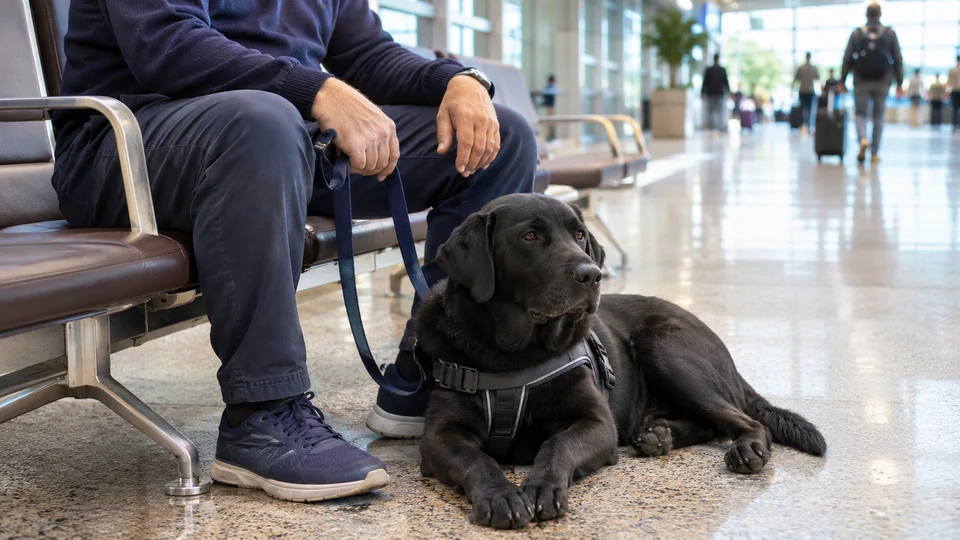 Calm behavior supports travel preparation; appearance or equipment alone does not establish service-dog status. Illustrative image.
DOT forms, short-notice bookings and long-flight relief
Section 382.75 permits an airline to require a current DOT Service Animal Air Transportation Form. For a segment scheduled for eight hours or longer, it may also require the DOT relief attestation. Current forms are completed on or after ticket purchase. Additional documentation is limited to applicable government animal-transport requirements.
For reservations made more than 48 hours ahead, an airline may require submission up to 48 hours before departure. For a reservation made less than 48 hours ahead, it cannot demand advance notice and may collect the forms at the departure gate. Missing a valid deadline on an earlier booking is different: the airline must make reasonable efforts to accommodate without delaying the flight.
The DOT air-transportation form and instructions address the dog's health, training and behavior. Complete statements truthfully, use accurate contact details and retain a copy of what you submit. The form goes to the airline, not to DOT for a personal certification.
Create a short preparation checklist: obtain the airline's current form link, confirm its submission channel, check each segment's scheduled length, and save the confirmation. If a booking changes, ask whether the airline needs an updated itinerary or submission. See applying the federal framework to a United itinerary for a practical example.
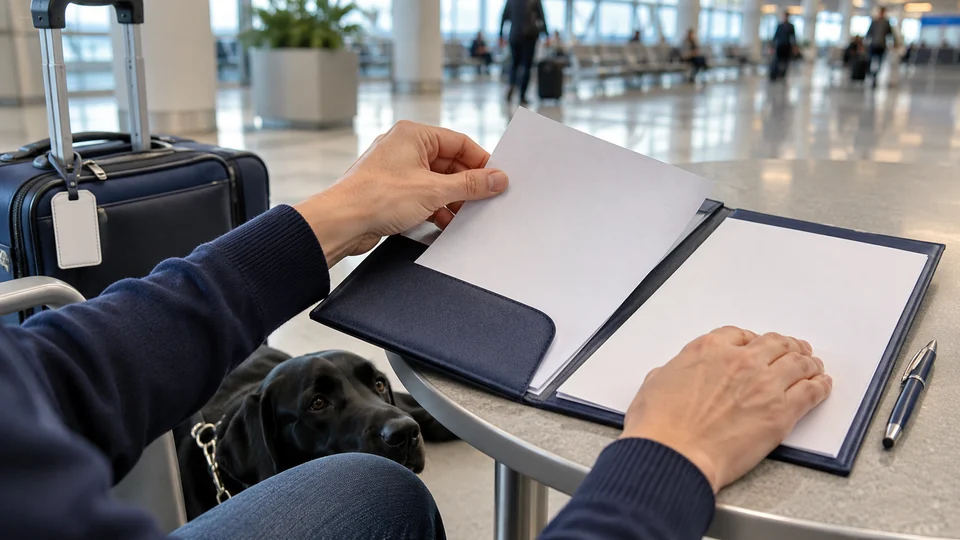 Organize the required forms and confirmations before travel. The pictured papers are illustrative, not official DOT documents.
Safe placement, public behavior and permitted refusal grounds
Service-dog access still involves safe placement. Under section 382.77, the dog may accompany the passenger in their foot space or on their lap when consistent with safety requirements and without encroaching on another passenger's space. If a large dog cannot fit, the airline must first offer an available suitable seat location in the same class. The rule includes conditional alternatives when cabin accommodation cannot be arranged; it does not promise a free upgrade or an empty neighboring seat.
Section 382.79 permits refusal for specified reasons, including a direct threat, significant disruption, applicable health or safety requirements, or failure to provide required current forms. Threat and behavior decisions must be individualized and based on objective evidence, independent of breed or type, with available mitigating measures considered.
Prepare for the setting your dog will encounter: crowds, waiting, close quarters and interruptions. Discuss any unresolved training concerns with a qualified trainer before booking. Plan relief opportunities and carry appropriate supplies. These preparations help you assess whether the proposed journey is suitable; they are not a substitute for meeting the legal definition.
The rule on charges prohibits charges for accommodations required by Part 382. That does not eliminate unrelated ticket, baggage or other ordinary travel expenses. Ask what a quoted charge is for rather than assuming every fee involving a passenger with a dog is prohibited.
CRO assistance, refusal records and complaint follow-up
If an unresolved disability-accommodation issue arises, ask for the airline's Complaints Resolution Official, or CRO. Section 382.151 describes the CRO's role and availability, including access in person or by telephone at no cost under the applicable carrier requirements. This is the airline's specialist in disability-related procedures.
Explain the problem calmly and specifically: which flight, what accommodation you requested, which forms you provided and what reason staff gave. Ask what can be resolved before departure. Keep timestamps, reservation details, copies of submissions and relevant correspondence.
When service-animal transport is refused, section 382.79 requires a written explanation at the airport or within ten calendar days. Preserve it with your records. DOT's Airline Passengers with Disabilities Bill of Rights explains complaint options. A complaint is a request for review, not a guarantee of compensation or a particular legal outcome.
You can contact ASA support for your assessment records when the issue concerns documentation ASA has issued. ASA is not the airline's CRO and cannot authorize boarding or decide an airline-law dispute. Seek qualified legal advice if you need an assessment of your specific rights or remedies.
Common Air Carrier Access Act questions
Is the Air Carrier Access Act the same as the ADA?
No. They are different laws with different settings and procedures. Use the ACAA and its aviation regulations for the airline questions discussed here; do not import a business's ADA procedure or a housing process into a flight reservation.
Does the ACAA require airlines to recognize emotional support animals as service animals?
No. Emotional support alone does not meet the current federal air-travel service-animal definition. A dog must meet the applicable disability-related task-training criteria; otherwise, investigate the operating airline's permitted pet arrangements.
What documentation may an airline request under the ACAA?
It may request the applicable DOT service-animal forms and documents required by relevant government animal-transport rules. A purchased registry is not a substitute. Check the airline's submission instructions and keep copies.
What happens if a service-dog trip is booked less than 48 hours before departure?
The airline may collect required forms at the departure gate, but cannot impose advance notice for that short-notice reservation. Complete them promptly and contact the airline to coordinate the journey.
Can an airline refuse a service dog because of its breed?
Breed alone is not the basis for the individualized threat or behavior assessment required by the rule. Separate applicable government entry or safety restrictions still need to be checked for the itinerary.
How do I ask for the airline Complaints Resolution Official?
Tell an airline representative you have an unresolved disability-accommodation concern and want to speak with its CRO. Ask for an accessible way to contact that person, explain the requested accommodation and keep a record of the discussion.
