
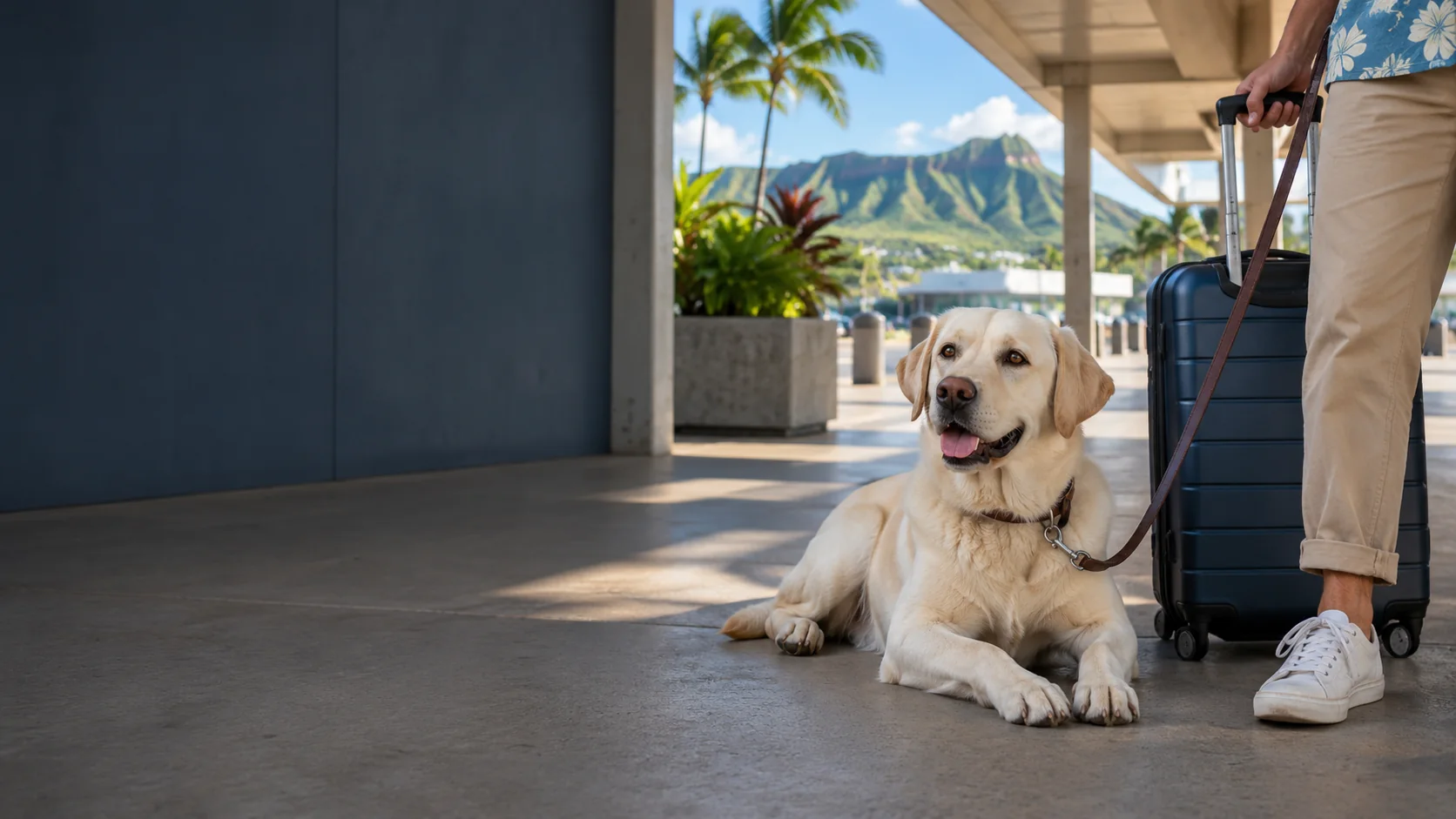
A service dog can have public-access rights and still need advance animal-entry preparation for Hawaii. The airline's permission to board, the state's rabies-control requirements and access to a hotel or restaurant are separate decisions. Completing one does not automatically complete the others.
Hawaii provides a route for qualifying guide and service dogs to enter without quarantine confinement when the state's requirements are met. That is a conditional process involving veterinary records, identification, advance coordination and arrival inspection. It is not a general exemption obtained by showing a service-dog vest.
This American Service Animals guide helps organize the arrival plan before flights are finalized. Use the Hawaii resource hub for related state information, and work from the current Animal Quarantine Branch instructions for the dog's actual itinerary. Do not combine deadlines from unrelated pet checklists and assume they apply to your case.
Separate airline, import and public-access requirements
First, ask the operating airline about its service-dog process, including forms, flight duration, seating and any connection requirements. Our Air Carrier Access Act guide explains the U.S. framework, but the airline still needs to review the actual itinerary and any destination restrictions.
Second, consult the Hawaii guide and service dog entry instructions. This is the state's animal-health process. The page defines qualifying trained work, excludes comfort alone from that definition and explains that animals still in training do not qualify for this service-animal entry route.
Third, understand the rules at your destination. Hawaii Revised Statutes section 347-13 addresses access to public places and conveyances with a qualifying service animal. The ADA also has public-access protections and limits. Neither is a substitute for the animal's pre-arrival health preparation.
A practical folder can have three tabs labeled airline, Hawaii entry and destination arrangements. Put each confirmation under the relevant tab. This prevents a common mistake: sending an airline approval to a hotel as if it were a universal credential, or assuming a hotel reservation means the animal has been cleared to enter the state.
Begin with the microchip, rabies record and blood test
The state's service-dog checklist requires an implanted electronic microchip and current rabies vaccination. Vaccination documentation must identify the product and specified lot information. Ask your veterinarian to check that the microchip can be read and that its number is consistent across the records before any travel-specific paperwork is prepared.
The same checklist requires a passing OIE-FAVN rabies antibody test before arrival, with a result of at least 0.5 IU. It describes a passing result as valid for three years and says the microchip number must accompany the laboratory request. Confirm the appropriate testing sequence and timing with the veterinarian and Animal Quarantine Branch; do not assume a routine rabies certificate alone replaces the test.
Make a record audit before booking appointments: microchip number, vaccination dates and product details, laboratory submission date, result and validity. Check spelling and identifying information as well as dates. An administrative mismatch can create uncertainty even when the veterinary procedure was completed correctly.
The Animal Quarantine information page links current forms, laboratory resources and the service-dog instructions. Use those official resources to resolve a discrepancy rather than relying on another traveler's paperwork. Ask the veterinarian to handle professional corrections through the appropriate process if a record contains an error.
This early review is particularly useful for a first visit, a dog with multiple microchips or a return trip after a long interval. It gives you time to determine which records remain valid and which steps need attention.
 Confirm that the dog's identification matches the veterinary and laboratory records.
Build a calendar around the arrival date
Use the planned arrival in Hawaii as the reference point for state deadlines. The service-dog instructions require a health certificate issued no more than 30 days before arrival, with the specified tick-treatment information for treatment within 14 days of arrival. Have the veterinarian select and document the appropriate treatment; a travel article is not a substitute for veterinary direction.
The instructions also require notification to the Rabies Quarantine Branch at least 24 hours before arrival, including arrival details and where the dog will stay. The department strongly advises sending required documents well ahead of the intended date. Treat that 24-hour notification as one element of an established plan, not a reason to leave all preparation until the previous day.
Write the planned flight number, arrival airport and local date clearly. A flight leaving the mainland late in the day or an itinerary changed after a delay can create confusion about which date controls. Ask how to update the branch and airline if the flight or accommodation changes.
Keep separate reminders for professional appointments, document submission, confirmation and final travel review. A completed appointment does not prove that records reached the right office. If you have not received the expected response, ask about the outstanding item while there is still time to address it.
For example, a traveler may have a valid blood test but discover that a health certificate was prepared too early for the revised arrival. Rechecking the calendar after a schedule change is more reliable than assuming a previously complete folder remains complete indefinitely.
Choose the port of entry before arranging connections
The official service-dog page identifies Daniel K. Inouye International Airport on Oahu as the entry point unless a valid Neighbor Island Inspection Permit has been issued. It expressly includes guide and service dogs in that requirement. A direct flight to another island therefore requires advance confirmation of the appropriate permit and inspection arrangements.
Do not buy a tight connection on the assumption that the dog can leave the arrival process immediately. The state's instructions describe airline transport to the Airport Animal Quarantine Holding Facility for verification and an external-parasite examination. Release occurs when the requirements are satisfied; it is not merely a matter of walking out with carry-on luggage.
Ask the airline how you and the dog will reach the required inspection location, what assistance is available and how a delay affects an onward flight. If mobility or distance is a concern, raise that before travel. The department's service-dog page notes that passengers may request airline assistance with transport to the facility and baggage claim.
For a neighbor-island arrival, use the current permit checklist and confirm the inspection provider, airport and airline participation directly. Keep the written arrangements with your itinerary. An inspection organized for one airport should not be assumed to transfer automatically if the flight is rebooked elsewhere.
Your accommodation plan should allow for an arrival that takes longer than expected. Let the relevant people know how you will communicate if the inspection or flight timing changes, without asking them to assume that service-dog status guarantees immediate release.
Handle ESAs, trainees and clinical documents accurately
Hawaii's service-dog entry instructions require individually trained disability-related work. They expressly exclude an animal whose role is only comfort or emotional support from that service-dog definition. A psychiatric service dog may perform qualifying work; a psychiatric diagnosis alone does not establish that the dog has been trained.
An animal still learning its service tasks does not qualify for the same entry route under the published service-dog instructions. Ask the Animal Quarantine Branch which animal-entry process applies instead. Do not relabel a trainee or ESA as a finished service dog to fit a planned arrival.
American Service Animals can support an individual evaluation for appropriate clinical documentation where available. Our PSD documentation guide explains the difference between evaluating a person's needs and training a dog. A clinical letter cannot substitute for the microchip, laboratory result, veterinary certificate or state inspection.

Find out if an ESA letter is right for you
A few guided questions. Your personal details come last.
If you already have documentation, review what it actually says and who issued it. A general statement about benefit from a companion animal is different from an airline form, and neither should be edited to imply veterinary clearance. Ask each responsible professional or agency to address its own part of the process.
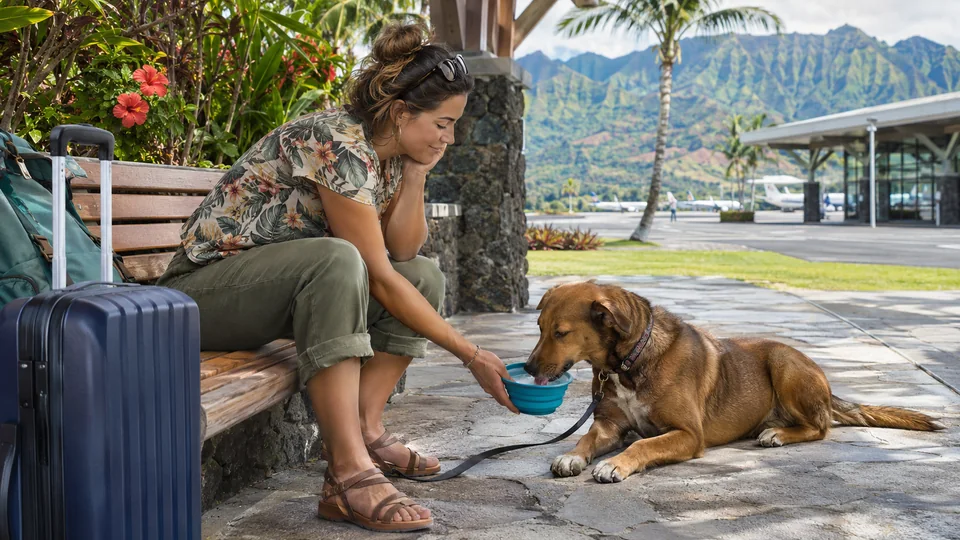 Plan a manageable arrival day after the required inspection and release.
Check the whole plan before departure and again before returning
Complete a final review using the actual booking, not the original itinerary saved weeks earlier. Confirm the operating carrier, arrival airport, any permit, the dog's identification, current records and the method for notifying the relevant office of a change. Carry the required originals and accessible copies in the way the airline and state direct.
Pack for the dog's normal care and for delays: appropriate water arrangements, cleanup supplies, food and any professionally prescribed items. Plan relief opportunities and ask the airline about the practical movement between arrival, inspection and baggage claim. Avoid relying on a stranger or airport employee to take over the dog's care.
After arrival, keep the release and travel records for future reference. A successful previous trip does not prove that every document will remain valid next time. The state service-dog instructions call for a valid health certificate for each entry, and other records have their own validity periods.
If you travel onward internationally or return after time outside the United States, review the separate destination and federal entry requirements as well. A Hawaii release decision is not a substitute for another jurisdiction's rules. A careful checklist respects each decision-maker's role and reduces the chance of an avoidable problem at the airport.
Hawaii service-dog arrival questions
Are service dogs automatically exempt from Hawaii quarantine?
No automatic exemption follows from a vest or letter. Qualifying guide and service dogs can enter without quarantine confinement when they satisfy the state's published conditions and arrival verification. Begin with the service-dog instructions and confirm the dog's records, itinerary and inspection arrangements before departure.
Does airline approval clear the dog for Hawaii entry?
Airline acceptance and Hawaii's animal-entry process are separate. The airline may review service-dog forms and seating while the state reviews identification, rabies-related records and other entry conditions. Keep both confirmations and ask about any unresolved requirement rather than assuming one approval covers the other.
Can I fly directly to a neighbor island with my service dog?
The state identifies Oahu's Daniel K. Inouye International Airport as the entry point unless a valid Neighbor Island Inspection Permit has been issued. This applies to service dogs too. Confirm the applicable permit and inspection arrangements for the precise airport before relying on a direct arrival elsewhere.
What advance notice does the service-dog checklist require?
The checklist requires arrival and lodging notification to the Rabies Quarantine Branch at least 24 hours in advance and strongly recommends sending the required documents well ahead of travel. Veterinary preparation has separate deadlines. Waiting until the final day to begin the entire process is therefore not a workable plan.
Does an emotional support dog use the same entry exception?
The published service-dog entry definition excludes comfort or emotional support alone and requires trained disability-related work. Ask the state which ordinary animal-entry process applies to an ESA or an animal still in training. A clinical evaluation does not change the dog's actual training or eliminate health requirements.
Do I need to prepare again after a previous successful visit?
Yes. Check every record against the next arrival date, including the health certificate required for each entry and any laboratory or vaccination validity. Reconfirm the airport and operating airline as well. Previous release is useful history, but it is not permanent clearance for all later travel.
