

A psychiatric service dog letter is clinical documentation, not a public-access license for a dog. American Service Animals (ASA) helps people explore an individual evaluation and, when appropriate, documentation from an appropriately licensed professional. Understanding that limited role helps you choose a service for a real clinical need rather than buy paperwork for a benefit it cannot provide.
This is American Service Animals' own service guide. “Official Site” identifies the ASA website; it does not mean government endorsement. Below, learn how a PSD letter differs from task training, housing decisions, and airline forms, and what to prepare before requesting an assessment.
What a psychiatric service dog letter can and cannot do
People use “psychiatric service dog letter,” “psychiatric service animal letter,” and “PSD letter” to describe a professional's documentation about a person's disability-related needs. Before requesting one, identify what you want the clinician to assess and where you intend to use the document. A useful clinical discussion begins with your circumstances, not a promise of access everywhere.
For ADA public access, a letter is not the deciding factor. The Department of Justice's service-animal requirements distinguish a disability-related trained service dog from an animal that provides comfort through its presence. Covered businesses cannot require medical documentation or a special identification card as a condition of service-dog entry.
That means you should not purchase a letter solely because you believe every service-dog handler must carry one. A clinician may address the person's clinical needs within their professional role; that assessment does not establish the dog's training, behavior, or suitability for every environment. Those are separate questions that require honest attention.
Task training is separate from clinical documentation
A psychiatric service dog's work must relate to the handler's disability. The ADA regulation's service-animal definition focuses on individually trained work or tasks, rather than the animal's reassuring presence alone. A diagnosis, a friendly temperament, and a purchased document are not substitutes for that work.
When preparing for a conversation, describe an actual task in ordinary language: what prompts the dog's response, what the dog does, and how that action assists you. Distinguish established skills from goals you hope to train. A retrieval exercise, for example, is only relevant to service work when it is trained to address the individual's disability-related need; fetching an object for play is not enough.
DOJ's service-animal FAQ explains that handlers may train their own dogs and that the ADA does not require a professional training program. Dogs still in training do not receive the ADA's public-access protection on that basis, although state or local rules may differ. If your dog needs further preparation, seek suitable training advice rather than using a letter to fill that gap.
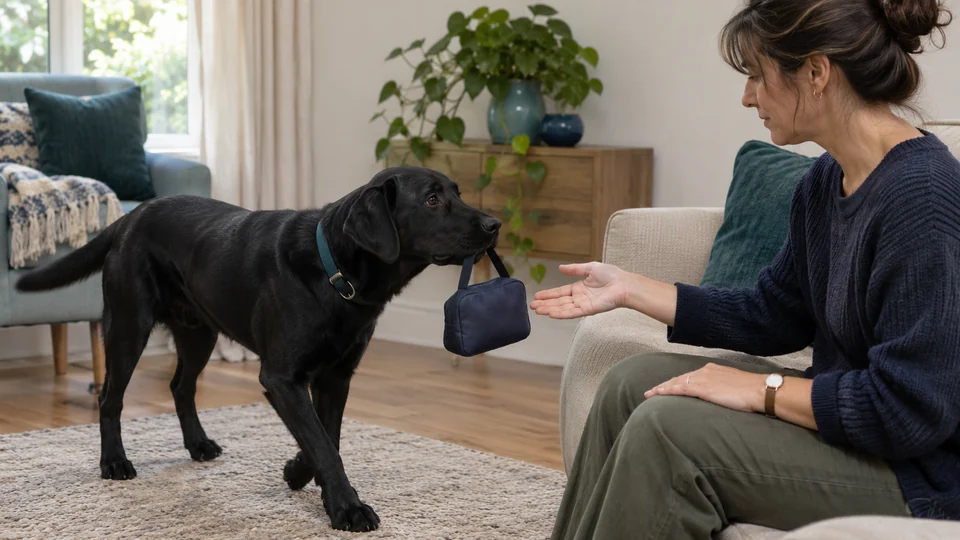
Preparing for an individual PSD-related assessment
An assessment should give the professional enough context to exercise independent judgment. You do not need to arrive with polished terminology or a self-written approval letter. Prepare a factual account of the difficulties you experience, their effect on everyday activities, and the support you are seeking. If you already receive care, ask how this request fits with that care.
- Explain why you are requesting documentation and who, if anyone, has asked for it.
- Separate the dog's current trained tasks from companionship and future training plans.
- Have relevant information about prior care available if the professional requests it.
- Confirm where you will be located during the evaluation so appropriate professional authorization can be checked.
- Ask how follow-up questions, corrections, and any additional assessment will be handled.
ASA's current service options include psychiatric-service-animal documentation with licensed professional review. Availability and the appropriate next step depend on your circumstances and an authorized provider's availability. A screening response or completed questionnaire is not a clinical conclusion. The clinician may need further information or may determine that the requested documentation is not appropriate.
If you would like to explore this process, use the assessment below or start an ASA intake. Describe your circumstances accurately. The purpose is to request individual clinical review where available, not to obtain airline approval or certify a dog's training.

Explore a PSD letter evaluation
A few guided questions. Your personal details come last.
Housing questions need their own assessment
A housing request should be evaluated in its own legal and factual setting. Do not assume that a PSD letter creates an automatic exemption from every animal restriction or charge. Keep the housing provider's request, your relevant clinical information, and any training information distinct so the actual issue can be assessed.
HUD's May 22, 2026 enforcement memorandum directs FHEO's animal-accommodation reasonable-cause findings and charge recommendations toward cases involving trained disability-assistance animals. The memorandum does not decide every housing dispute, excludes Section 504 and ADA complaint processing from its scope, and preserves private court actions. Agency enforcement policy should not be confused with a blanket outcome for your tenancy.
Explain a housing deadline early and obtain qualified legal advice for a dispute. If your question concerns emotional support rather than trained tasks, begin with our ESA letter evaluation guide. A different label on a document does not resolve the underlying facts.
Air travel requires the correct service-dog process
Air travel has its own documentation framework. DOT's service-animal rule announcement explains that psychiatric service dogs are treated as other service animals, while emotional support animals are not service animals under that rule. Buying a PSD letter does not change the category of an untrained emotional support dog.
Under 14 CFR 382.75, an airline may require the DOT Service Animal Air Transportation Form and, for a flight segment scheduled for eight hours or more, the relief attestation. Additional documentation is limited to applicable federal, territorial, or foreign animal-transport requirements. A clinical letter is not a replacement for these forms.
Build your travel checklist around the operating airline, route, dog, and required submission process. Keep veterinary and destination-entry requirements separate from clinical documentation. Check timing before departure and retain confirmation of what you submitted. Our Air Carrier Access Act guide explains the framework; our United travel guide shows how itinerary planning differs for pets and trained service dogs.

Questions to ask ASA before choosing a service
Choose the service around the assessment you need, not the number of documents in a bundle. ASA's pricing page currently lists a PSA Letter option, described as psychiatric service animal documentation, and a PSD letter, certificate, and ID-card bundle. Check the current inclusions, delivery format, total price, and terms before selecting a plan.
A private certificate or card can organize identifying information, but it does not add ADA rights. Read our registration and private-records guide before deciding whether an optional item is useful to you. Do not treat a printed validity date as a universal legal renewal requirement for every setting.
Ask who will evaluate your request, whether they can serve you in your location, what follow-up may be needed, and what happens if documentation is not clinically appropriate. Use ASA support for service questions and the ASA FAQ for process information. American Service Animals can help you explore an assessment where available; the professional's judgment and any separate accommodation decision remain individual.
Questions about ASA psychiatric service dog letters
Is a psychiatric service dog letter required for ADA public access?
No. A covered business cannot require a medical letter or special dog ID as an entry condition. Focus on whether the dog meets the applicable service-animal requirements. Do not buy clinical documentation solely because you think every handler must show a letter at a shop or restaurant.
Can a PSD letter turn my emotional support dog into a service dog?
No. A document does not teach the dog a disability-related task. If your animal provides comfort through companionship, describe that honestly. Discuss clinical needs with a qualified professional and training needs with an appropriate training resource rather than choosing a label to obtain access.
Who can evaluate whether PSD-related clinical documentation is appropriate?
An appropriately licensed professional acting within their scope and authorization can assess the clinical question. Confirm that the provider can serve you where you are located. Through ASA, ask about availability and the evaluation process; neither completing intake nor selecting a package guarantees a letter.
Can I use a PSD letter instead of airline DOT forms?
No. Follow the airline's applicable DOT-form process and any permitted destination-related requirements. Keep your clinical paperwork separate from your travel checklist. If an airline request is unclear, ask its accessibility team what information is needed for your itinerary rather than sending unrelated documents.
Can my existing treating clinician discuss PSD-related documentation?
Yes, you can raise the question with a clinician already involved in your care. They can explain whether it is within their role, what information they need, and whether a recommendation is appropriate. They are not required to provide a requested letter simply because you ask.
Does buying an ASA PSD service guarantee approval or housing acceptance?
No. Clinical review can result in a decision that documentation is not appropriate. A housing provider's response is a separate matter governed by the facts and applicable law. Review current service terms before purchasing, and obtain qualified advice if you need help with an accommodation dispute.
