

Searching for North Carolina service dog registration can lead to three very different things: a voluntary state tag, ordinary local dog licensing, and a commercial identification product. Only the first is the North Carolina Department of Health and Human Services program. None replaces the disability-related training that makes a dog a service animal.
For most visits to shops, restaurants, libraries and other places covered by the Americans with Disabilities Act, a handler does not need to produce a service-dog registration tag. North Carolina's own agency describes its registration program as voluntary. The practical challenge is understanding when a tag is optional, what staff may ask instead, and how the rules differ while a dog is still learning.
This guide from American Service Animals focuses on that paperwork question. For broader state resources, use our North Carolina information hub; for the distinction between emotional support and trained assistance, see our animal-role and registration guide.
The North Carolina service-animal tag is voluntary
The NC DHHS service-animal registration page says registration is optional for both service animals and animals in training. Its purpose should not be confused with a mandatory entry permit. A business covered by the ADA cannot make participation in a voluntary registry a condition of serving a person with a qualifying service dog.
North Carolina's registration statute, G.S. 168-4.3, authorizes the department to issue registrations and tags. It also says there is no fee for the application, registration, tag or replacement. That makes the state program distinguishable from a website selling a registration package. Check the issuing organization before entering personal information or paying for anything described as a required state credential.
A tag may be convenient for someone who chooses the program, but its presence does not excuse a dog that is uncontrolled or not housebroken. Conversely, a missing tag does not erase an otherwise qualifying handler's ADA rights. Training and behavior remain relevant whether the collar has a tag, a simple identification disc or no special service designation.
A useful personal filing system has separate folders for the optional state application, the dog's routine veterinary and licensing records, and any documents needed for a particular housing, employment or travel process. Keeping these separate helps prevent the assumption that one document answers every access question.
What a business may ask when there is no tag
The Department of Justice service-animal FAQ explains the federal public-access standard. When the reason for the dog is not apparent, staff may ask whether the dog is required because of a disability and what work or task it has been trained to perform. They may not demand a training certificate, ask the handler to disclose a diagnosis or require a demonstration of the task.
Prepare an accurate description of the action the dog performs. “She retrieves dropped items when I cannot reach them” describes work; “she makes me feel better” describes comfort without identifying training. This is not a script for turning a pet into a service dog. The answer must reflect the dog's actual training and the handler's disability-related need.
Psychiatric disabilities can involve trained service work, just as physical disabilities can. The important distinction is between a learned action that assists with a disability and reassurance provided by an animal's presence alone. A vest, medical letter or breed choice does not settle that distinction.
If an employee asks for registration, clarify that North Carolina's program is voluntary and offer the official agency page. A short explanation is usually easier to follow than a large collection of unrelated forms. If the concern is the dog's behavior, address that concern directly; optional paperwork will not resolve an actual control problem. The ADA also allows separate treatment of some settings, so do not apply a shop-entry conversation automatically to an employer, airline or housing provider.
If you choose to apply, use the actual state process
Begin from the DHHS page rather than a search advertisement. It links the current application and explains that both pages must be completed with the required signatures. The agency also describes how an owner-trained dog's work may be affirmed: a witness who has observed the tasks signs the training affirmation. Read the form in full before asking someone to sign it.
Make sure names, contact information and the animal's identifying details are consistent. A witness should attest only to what they have actually observed. Do not substitute a general statement that the dog is friendly for an affirmation about disability-related tasks. If a section does not fit your circumstances, ask the department for clarification rather than inventing a training history.
Keep a copy of what you submit and a note of when it was sent. DHHS says a complete application leads to an approval letter and collar tag; it does not turn an incomplete application into immediate proof of approval. Allow the department to explain any missing information or follow-up requirements. This article does not promise an administrative processing time.
For example, a handler might decide that the free state tag is useful for personal organization while continuing to use ordinary ADA access rights before it arrives. Another handler might choose not to enroll at all. Neither choice changes the need to maintain effective control, follow applicable animal-health rules and accurately describe the dog's trained work.
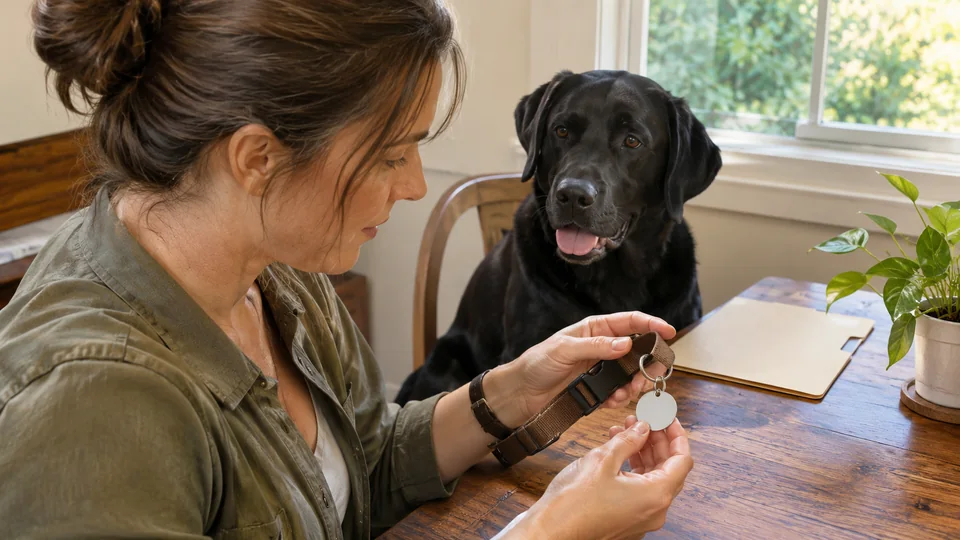 Keep optional service-animal paperwork separate from everyday identification and veterinary records.
Dogs in training need a separate state-law check
The ADA's public-access rules generally cover dogs already trained to perform disability-related work. They do not create the same general entitlement for a dog that is only in training. North Carolina provides additional state protection, but it has its own conditions.
G.S. 168-4.2 addresses access for people training a service animal. It requires the animal to be accompanied by a trainer and identified through the specified collar-and-leash, harness or cape arrangement as an animal in training. The trainer remains responsible for damage. Review the actual wording when planning practice, because an optional registration tag and the statute's identification requirement are different matters.
A sensible training visit has a limited objective: settling near an entrance, moving past a cart or maintaining attention during a brief transaction. Choosing a quiet time and leaving before the dog becomes overwhelmed are training decisions, not proof that the dog has already completed its work. A crowded event is a poor place to discover that a puppy cannot recover from noise or close contact.
Describe the stage honestly when speaking to a manager. Do not answer that the dog is fully trained if the relevant task is still being taught. If a destination has a complicated setting, such as a treatment area or a venue involving other animals, discuss the actual access question with the responsible organization. When uncertainty remains, seek advice about that setting rather than stretching a general registration rule beyond its purpose.
Ordinary licenses, housing letters and flight forms do different jobs
“No service-dog registration required” does not mean “no animal paperwork ever.” The DOJ distinguishes special service-animal registration from local dog licensing and vaccination rules that apply generally. Check the city or county animal-control requirements where the dog lives, and retain accurate veterinary records. A voluntary DHHS tag is not a substitute for routine compliance.
Housing involves another analysis. An assistance-animal request concerns the use and enjoyment of a dwelling and the law applying to that property. A state's optional tag cannot guarantee acceptance, establish a clinician's findings or decide a disputed fee. Start with the actual request and the provider's response, and use our landlord and accommodation guide to organize the questions that need further review.
Airlines also follow a different framework. A dog that qualifies for ADA access at a restaurant does not thereby satisfy every operating carrier's submission, behavior, size or destination-entry requirement. Our Air Carrier Access Act guide explains why flight preparation must be handled separately.
American Service Animals offers an individual evaluation pathway for people exploring appropriate clinical documentation. An evaluation does not issue North Carolina's government tag, train a dog or create a universal access pass. If documentation is your concern, identify its intended use before beginning so that a professional can consider the right question.

Find out if an ESA letter is right for you
A few guided questions. Your personal details come last.
Respond to a tag dispute with a clear record
If access is refused solely because there is no registration tag, first ask whether a manager can review the issue. Explain that the state program is voluntary, answer the permitted task questions accurately and keep the dog under control. You do not have to resolve a legal disagreement through an extended confrontation at the doorway.
Once you are in a safe, workable place, record the business name, address, time, requested service and the reason given. Distinguish “no tag” from a concern about barking, housebreaking, a restricted area or another specific issue. Save a written policy or message if one was provided. A factual account is more useful than guessing why an employee acted as they did.
The DOJ complaint page explains how to report an ADA concern. Filing a complaint is not a guarantee of an investigation or a particular outcome. A disability-rights organization or qualified lawyer can help identify the appropriate route for a situation involving additional state-law issues.
For future visits, keep a bookmarked official reference and a concise explanation of the dog's work available. Treat them as communication aids, not compulsory credentials. The aim is a repeatable, calm routine: accurate description, controlled behavior, ordinary animal care and the correct legal framework for the place you are visiting.
North Carolina registration questions
Is North Carolina service dog registration mandatory?
No. NC DHHS identifies its registration scheme as voluntary, including for animals in training. ADA-covered businesses cannot require enrollment in a service-animal registry as an entry condition. Ordinary local dog licensing and animal-health requirements remain separate, so check those obligations even if you decline the optional state program.
Does the state charge for a service-animal tag?
G.S. 168-4.3 says no fee may be charged for the state application, registration, tag or replacement. A commercial product sold online is a different offering. Verify that you are using the DHHS application if your intention is to join the North Carolina government program.
Can an owner-trained dog apply for the voluntary tag?
The DHHS instructions include a training affirmation for self-trained animals, signed by a witness who has observed the tasks. Follow the current application's requirements and provide truthful information. Eligibility for an administrative registration should not be confused with permission to describe unfinished training as completed service work.
Can a store insist that I show an ESA letter?
A medical letter is not the ADA proof-of-entry requirement for a task-trained service dog. Where the need is not obvious, staff may ask the two limited service-animal questions. An animal that provides only emotional comfort does not gain ordinary ADA public-access rights because its handler carries an ESA letter.
Does a dog in training need identification in North Carolina?
The state's training-access provision includes identification conditions and requires the animal to be accompanied by a trainer. Read G.S. 168-4.2 for the specified arrangements. That requirement is distinct from the voluntary DHHS registry and from the federal rules for an already trained service dog.
Will an ASA document replace the North Carolina application?
No. American Service Animals' clinical evaluation process and the state's registration program have different purposes and issuers. Use the DHHS process for a state tag. If you need clinical documentation for a specific accommodation request, seek an individual assessment without assuming that any resulting document guarantees an access decision.
