
1Screening questions, no cost
Give your state and town, describe each animal by name, type, breed, weight and sex, with a photo if you like, and answer the PHQ-9 and GAD-7 mood questionnaires. The screening costs nothing.
An ESA letter West Hartford landlords, condo boards and residence halls can review starts with a free online screening, after which a clinician licensed in Connecticut meets you privately over video or by phone. That clinician decides which letter, if any, fits: one for an emotional support animal in housing, or one documenting your need for a psychiatric service dog. Whatever you hand over then rests on a real evaluation rather than a registry page.


A West Hartford ESA evaluation moves through three stages: a no-cost screening, a purchased plan that includes a live session, and then your clinician decides.
Give your state and town, describe each animal by name, type, breed, weight and sex, with a photo if you like, and answer the PHQ-9 and GAD-7 mood questionnaires. The screening costs nothing.
Your plan is chosen and paid for at checkout. Next, a guaranteed live telehealth session is included in every evaluation: you and a clinician licensed in Connecticut speak over video or phone, once or more often if that clinician wants. Your clinician-client relationship starts in that conversation.
Once the clinician backs your request, the signed letter lands in your account, ready to send to a landlord or a campus housing office. If not, our refund policy takes over.
Pricing
Compare the current evaluation fees, read live from our checkout. The screening costs West Hartford residents nothing. You select a plan and settle it at checkout, after which the evaluation gets under way. Under our refund policy, a person the clinician finds ineligible gets the whole price back by asking within 30 days of purchase, an option that ends once a letter has been issued and delivered. Questions? Read our FAQ page or contact us.
Clinical review for one emotional support animal and a Connecticut housing letter.
$149.00/ one-time
One evaluation covering the support provided by each of your animals in a Connecticut home.
$159.00/ one-time
A psychiatric service dog evaluation with a clinician licensed in Connecticut.
$199.00/ one-time
Compare the combined letter and document options.
An ESA letter and certificate together in one document package.
$199.00/ one-time
A PSD letter, certificate and ID card in one package.
$225.00/ one-time
Need help choosing? Take the free screening first or compare every plan. Documentation depends on clinical approval; optional certificates and cards do not establish access rights.
A clinician licensed in Connecticut stands behind every West Hartford ESA letter we deliver: the same person talks with you live, over video or by phone, reaches the decision and signs under that license. A no-pet clause stays in your lease, and the letter supports your request for an exception to it, which is why every emotional support animal letter or PSD letter from us follows a live evaluation and never a form alone.
Searchable on eLicenseYour clinician's name and Connecticut license appear on the letter, and the license can be checked on Connecticut eLicense, the state's public lookup.
Spoken live, sometimes twiceThe session is live; it can run past its usual length or happen again when your clinician wants more time, and a careful evaluation sometimes ends with no letter.
Made for housingAn ESA letter belongs in a housing file: a lease, a condo association or a residence hall. Stores, buses and town parks run on separate rules, and the optional certificate and ID card we sell give no access rights anywhere.
A separate letter for trained dogsA psychiatric service dog letter records your disability and why a task-trained dog helps with it. Training happens elsewhere; the letter neither trains nor certifies a dog.
An ESA, short for emotional support animal, is an animal whose company a licensed clinician finds helps with the effects of a person's disability, and it needs no task training. An ESA letter is that clinician's signed statement supporting your request that a landlord make an exception to a no-pet rule.
An ESA shares your home without any special training, and that gives it no right to come along into shops, restaurants or town buildings. The ADA reserves that access for dogs whose training lets them perform work or tasks tied to a disability.
If a clinician supports it, the letter a tenant gives a landlord lists every approved animal by name, displays the signing clinician's Connecticut license and states an expiry date. It lives in your account as a digital document. No official ESA registry exists in Connecticut, and the 2025 registry bill, H.B. 6216, never got out of committee.
Three ESA West Hartford rules a letter leaves alone
Usually yes: the state's accommodation rule reaches most West Hartford rentals, though Section 46a-64c leaves out two kinds of homes shared with a resident owner: a room let inside the owner's single-family house and the second unit of an owner-occupied two-family.
About one West Hartford household in three rents its home, according to American Community Survey figures for 2020 to 2024 in the 2026 town profile that the town links as its demographics page. The town's 2020-2030 Plan of Conservation and Development places most multi-family districts on the east side, between Fern Street and New Britain Avenue, with the larger apartment properties along Albany, Farmington and New Britain Avenues (2018 data).
Section 46a-64c treats as discrimination a landlord's refusal of a reasonable accommodation that a disabled West Hartford renter may need to live in the apartment on equal terms, and an exception to a no-pet clause for an ESA is requested as exactly that. Federal enforcement shifted on May 22, 2026: a HUD memo still presumes that requests for trained animals are reasonable, while waiving pet rules for untrained ESAs gets no such presumption. The memo left untouched the Fair Housing Act itself, the option of a private lawsuit and Connecticut's own statute, so ESA requests stay open to West Hartford tenants, while a task-trained psychiatric service dog sits on the firmest footing.
Connecticut law adds neither a waiting period nor an official form for ESA letters. A clinician must still know you before putting anything in writing, and that knowledge begins in the live telehealth session included in every evaluation.
Renting one room inside a single-family house its owner lives in falls outside Section 46a-64c. Ask Statewide Legal Services which protections, if any, still apply before you count on one.
Section 46a-64c also skips the second unit of a two-family whose owner occupies the first. Your request goes to that owner, and whether federal law reaches the building is a question for a lawyer.
Section 46a-64c applies. The owner or a manager reviews your request, so give it in writing with the letter attached and keep a copy.
A management office normally handles the request. Ask the office for any accommodation form it uses, include your letter, and log the date you turned everything in.
The West Hartford Housing Authority manages housing in town, two elder care communities among it, and administers Housing Choice Vouchers. If you live in one of its properties, ask the Authority how it takes accommodation requests; with a voucher in a private rental, the request goes to that landlord. The office is at 80 Shield Street, (860) 953-0002, and is closed to the public on Wednesdays.
Give the owner, manager or leasing office a short written request with the letter attached, note the date, and keep copies of everything either side sends. A follow-up in writing after a week of silence keeps the record clear if you later need help from one of the offices below.
Three: the Town Clerk's dog license page says a town ordinance allows only three dogs per household, and the zoning code's definitions in Section 177-2 call keeping four or more dogs over six months old in one dwelling unit a kennel.
Every dog six months or older needs its own license from the Town Clerk by June 30, and an ESA dog is no exception.
An ESA letter is addressed to your landlord rather than the town. Before a fourth dog comes home, ask the Town Clerk at 860-561-7430 how the three-dog limit applies to your household.
A single ESA letter may list more than one animal, provided your clinician supports each of them, and a landlord judges every animal request separately. Our Connecticut ESA laws guide explains a 2026 Connecticut Supreme Court case about a second emotional support dog.
A West Hartford dog license costs $8.00 for a spayed or neutered dog and $19.00 for an unaltered one, and the Town Clerk lists the service dog license as free. That free license follows Section 22-345, which waives the fee for a person with a disability whose dog has been trained as a service animal; an ESA dog pays the regular fee.
Mail the town's dog license form, or the same details handwritten on plain paper, with payment, a self-addressed stamped envelope and your vet's rabies vaccination certificate to the Town Clerk's Office, 50 South Main Street, Room 313. The metal rabies tag does not count as proof. If the certificate does not show that the dog is spayed or neutered, add the vet's separate certificate, and the office mails the license and tag back.
Questions go to 860-561-7430 or LicenseMyDog@WestHartfordct.gov, and Room 313 is open weekdays, 8:30 a.m. until 4:30 p.m.
West Hartford Animal Control, listed under the police department, rescues injured animals, picks up strays, investigates complaints and cruelty cases, and keeps the town shelter where owners reclaim lost pets; call 860-570-8818. Lost pets and pets ready for adoption are posted on Animal Control's Facebook page. Adopting while you rent? An ESA letter names each approved animal, so a new dog appears on one only after your clinician supports it, and it still needs a license.
An ESA dog can walk in any West Hartford park except Westmoor Park, held on no more than six feet of leash, under the same town rules as every other dog.
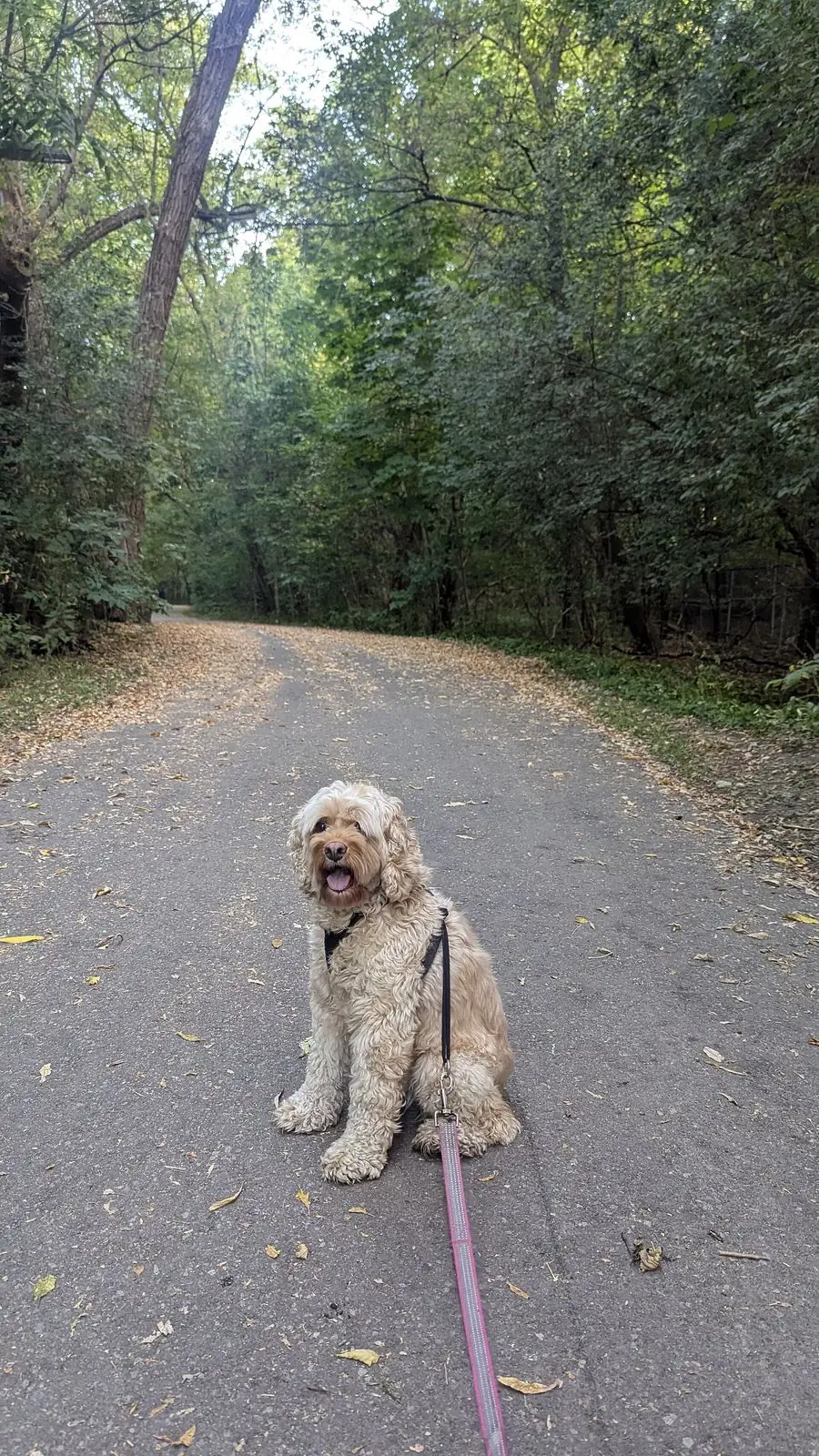
Town Code Section 128-3 makes it unlawful to bring a dog into a town park or playground on anything longer than a six-foot leash, and the town's park FAQ says the same.
Under Section 115-26, the owner and the person walking the dog must remove its waste at once from public property and from the common areas of private property, so the lawn and paths of an apartment complex count. Only a guide dog accompanying a blind person is exempt.
The same park rules bar anyone from a park or playground after 9:00 p.m. unless taking part in a supervised town program.
Section 128-3 also keeps pets out of active play areas, apparatus areas, athletic fields and recreation enclosures or buildings unless the pet is part of a town program. Westmoor Park, the town's 162-acre farm and nature education center on Flagg Road, does not permit dogs; in 2024 it earned Level II arboretum accreditation.
Training changes the answer at almost every West Hartford stop: a dog taught specific work or tasks for your disability can ride CTtransit, enter shops in West Hartford Center and wear a free town tag, while an emotional support animal can claim none of these by right. When a dog's work is not apparent, ADA rules limit staff in a West Hartford Center shop to two questions: does a disability require the dog, and which trained task or work does it perform? Paperwork cannot be demanded.
Town Clerk, Room 313
Trained dogListed as free
ESA$8.00 or $19.00, like any dog
Riding CTtransit or CTfastrak
Trained dogWelcome on every vehicle, leashed or under control
ESANo published right to ride; call 860-525-9181 first
Shops in the Center and Blue Back Square
Trained dogAdmitted, with two questions at most
ESANo public access
University of Saint Joseph grounds
Trained dogNo registration needed to use campus facilities
ESAResidence hall only after written approval
Your rental home
Trained dogPresumed reasonable in HUD's 2026 memo
ESAA request your landlord weighs
Our PSD letter belongs to housing: it describes the disability and the reasons a trained dog helps. The training is done by you or a trainer, and no letter can stand in for it or certify it.
Only a trained service animal rides by right: CTtransit says service animals are welcome in every facility and on every vehicle it runs, wants any animal kept under its owner's control, and posts no rule at all for emotional support animals.
CTtransit's definition covers an animal individually trained to work or do tasks for its handler's disability. It travels leashed, harnessed or tethered; if that gear would get in the way of its job, or your disability rules gear out, you keep it in check by voice, signals or other effective means.
The rider tips say that any animal must stay under its owner's control in all circumstances, and CTtransit publishes nothing that treats an ESA as a service animal. Call customer service at 860-525-9181 before you ride.
The town's Disability Services page lists Dial-A-Ride for residents 60 or older, or 18 or older with a qualifying disability, who are unable to use public transportation.
CTtransit routes and CTfastrak stations that serve West Hartford
Each West Hartford university decides ESA requests itself: the University of Hartford asks for its own packet and Provider Form and can take up to 45 days, while the University of Saint Joseph accepts its own form or a letter from your health care provider and sets no fixed deadline.
Following the Fair Housing Act, the Dean of Students Office works through each campus housing request with the student. Email access@hartford.edu for the Emotional Support Animal Application Packet: it holds an agreement form and the university's own registration form, and it asks for a veterinarian's statement of good health, current immunization records, a photo of the animal and a completed Provider Form from a health professional. An outside letter is not that Provider Form, so ask for the packet first. Questions go to Access-Ability Services at 860-768-4312.
Date due
No ESA may come to campus before formal approval.
The Office of Accessibility Services works with Residential Life on housing accommodations. Send its Housing Accommodations Request Form with documentation, either the university's Documentation of Disability Form for Housing Accommodations or a letter from your health care provider or treating professional. The request does not replace the eRezLife housing application, which you still file by Residential Life's deadlines. The office is in McGovern Hall Student Center, Office 201, 860.231.5730.
Date due
A school's own office has the last word on its housing, so ask it first; for any other Connecticut school, start with our guide for Connecticut college students.
Every West Hartford neighborhood is in reach because the session happens by telehealth: Bishops Corner to the north, Corbins Corner to the southwest and Elmwood to the southeast get the same evaluation. The years below come from the town's historic sites page and its 2020-2030 plan.

The first of three meeting houses of the First Church of Christ rose at Farmington Avenue and North Main Street in 1712. Town Hall is at 50 South Main Street, a cast-aluminum sign on Unity Green maps the town's 39 marked historic sites, and route 60 is named for the Center.
The crossing of North Main Street and Albany Avenue grew up after the Talcott Mountain Turnpike of 1797 and 1798, and Goodman's tavern there became the town's first post office in 1820. The 2020 plan lists a post office, library and senior center there; route 62 carries the name.
A town sign marks the Burgoyne Elms, planted by 18th-century residents to celebrate the capture of General John Burgoyne's British army at Saratoga in October 1777. Elmwood Center runs along New Britain Avenue between Mayflower Street and New Park Avenue, a short walk from the Elmwood CTfastrak station.
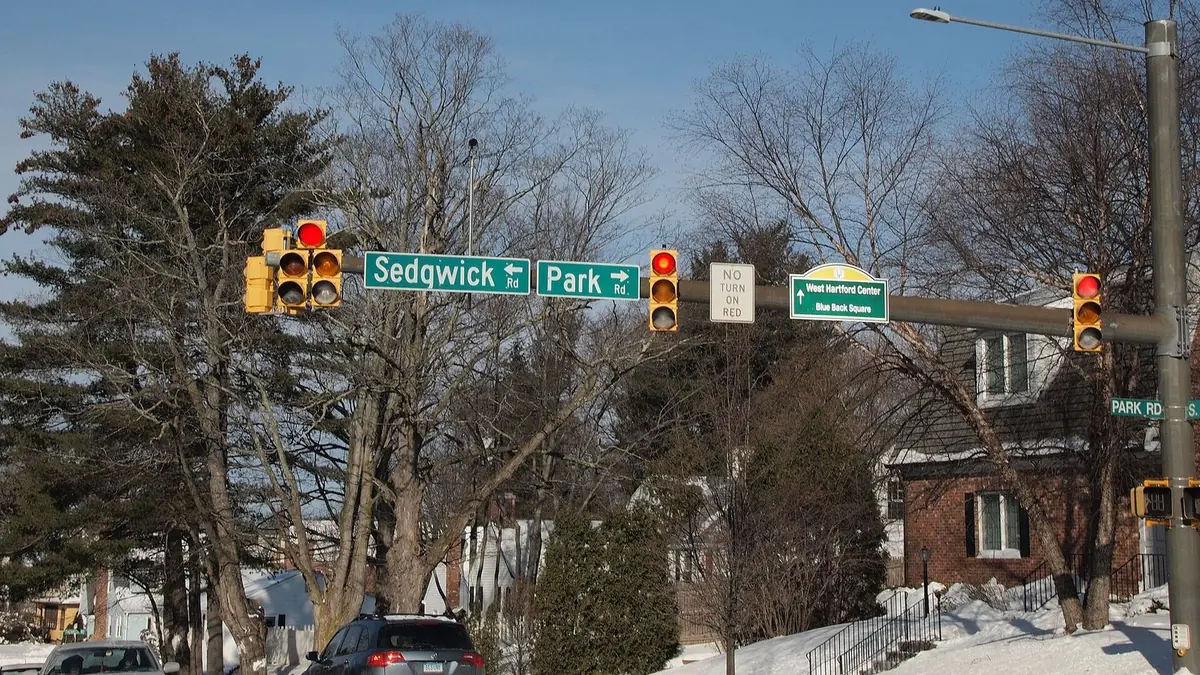
Park Road began as a streetcar corridor to downtown Hartford, and most of its buildings date to the 1930s. The district runs between South Quaker Lane and Prospect Avenue, and route 33 bears its name.
Corbins Corner sits in the southwest corner of town on New Britain Avenue, Route 71, and its original shopping center went up in the 1960s. About a third of Westfarms Mall, across from it, lies in West Hartford.
The eastern-border district runs from Flatbush Avenue to New Britain Avenue and holds the Flatbush Avenue CTfastrak station. In 2018 the Housing Authority finished a 54-unit mixed-use building on the avenue near the Elmwood station, the 2020 plan notes.
Discrimination in West Hartford housing is reported to CHRO's Housing Discrimination Unit, which sits in Hartford and accepts complaints up to 300 days after the act; rent increases belong to the town's Fair Rent Commission, and free legal advice usually begins with Statewide Legal Services. Facing the loss of your home? The town's Social Services page points to 211: choose option 3, then option 1.
Run by the state's Commission on Human Rights and Opportunities (CHRO), this unit takes every housing discrimination complaint filed with the commission, and Section 46a-82 sets the filing window at 300 days from the alleged act. Ask the staff how they handle untrained ESAs after HUD's 2026 memo.
450 Columbus Boulevard, Hartford · (860) 541-3403 · chro.housing@ct.govThe Fair Rent Commission hears complaints of excessive rent: a steep increase above what similar apartments cost, a cut in a major service the landlord used to supply, or a raise that looks like retaliation for a repair request or a complaint to the town. A staff liaison works with both sides before any hearing.
Complaint form on the commission's town pageCTLawHelp names Statewide Legal Services as the usual entry point to legal aid in Connecticut: it may advise you by phone, mail information or refer you to a legal services office or a private attorney, at no cost to the client. The May 2026 legal services brochure adds a line just for housing problems.
1-800-453-3320 · housing problems 1-800-559-1565Tenants who meet housing discrimination can turn to the Connecticut Fair Housing Center, whose website offers tenants a Disability Letter Generator.
60 Popieluszko Court, Hartford · 860-247-4400 · 888-247-4401West Hartford's Disability Services page names Disability Rights Connecticut, a statewide nonprofit and an affiliate of the National Disability Rights Network, for legal advocacy that includes discrimination.
75 Charter Oak Ave., Suite 1-101, Hartford · 860-297-4300 · 800-842-7303 in CTType your clinician's name into eLicense, the State of Connecticut's license lookup, and check the result before any letter reaches a landlord or a school.
elicense.ct.gov · free public searchBegin with our free online screening; after checkout, a clinician licensed in Connecticut evaluates you live by video or phone. A letter that clinician supports carries their name and Connecticut license, and any landlord can confirm the license on Connecticut eLicense.
Yes, if that therapist is licensed and knows your situation; a provider already treating you is often the most direct route. The University of Saint Joseph takes a letter from your health care provider, while the University of Hartford wants its own Provider Form completed.
It depends on your health, not your address. Your clinician looks at how a mental health condition affects everyday functioning and how the animal helps, and the result can be a no, in which case our refund policy applies.
Yes. The Town Clerk licenses an ESA dog at the ordinary rate, $8.00 when it is spayed or neutered and $19.00 when it is not, plus $1.00 for every month past June 30; only the service dog license is listed as free.
Check with the town first. The Town Clerk's page says a town ordinance allows three dogs per household, and an ESA letter is addressed to your landlord, so call 860-561-7430 before a fourth dog arrives.
No. Westmoor Park bars dogs, and an ESA gets no exception. Every other town park lets a dog in on a leash of up to six feet, as long as it stays off play areas and athletic fields.
Animal Control at 36 Brixton Street, phone 860-570-8818. The division handles strays, injured animals, complaints and the town shelter, and it posts lost and adoptable pets on its own Facebook page.
No. The University of Hartford does not permit an ESA on campus until it grants formal approval, and review can take up to 45 days after your documents arrive, so email access@hartford.edu early.
Yes, if your clinician finds it sufficient. Connecticut's telehealth law, Section 19a-906, counts audio-only phone calls as telehealth, though not texting, fax or email, and every evaluation with us includes a live video or phone session.
CHRO's Housing Discrimination Unit, 450 Columbus Boulevard in Hartford, (860) 541-3403, takes it; you have 300 days from the alleged act to file under Section 46a-82, and a rent increase goes to the town's Fair Rent Commission instead.
The Authority itself: call (860) 953-0002 or visit 80 Shield Street, which is closed to the public on Wednesdays, and ask how it takes accommodation requests. A voucher holder renting privately asks that landlord instead.
Neighboring and other Connecticut city pages
Take the screening at no cost, choose a plan at checkout, then speak live with your clinician by video or phone; you receive a signed letter only if that clinician supports one.
