
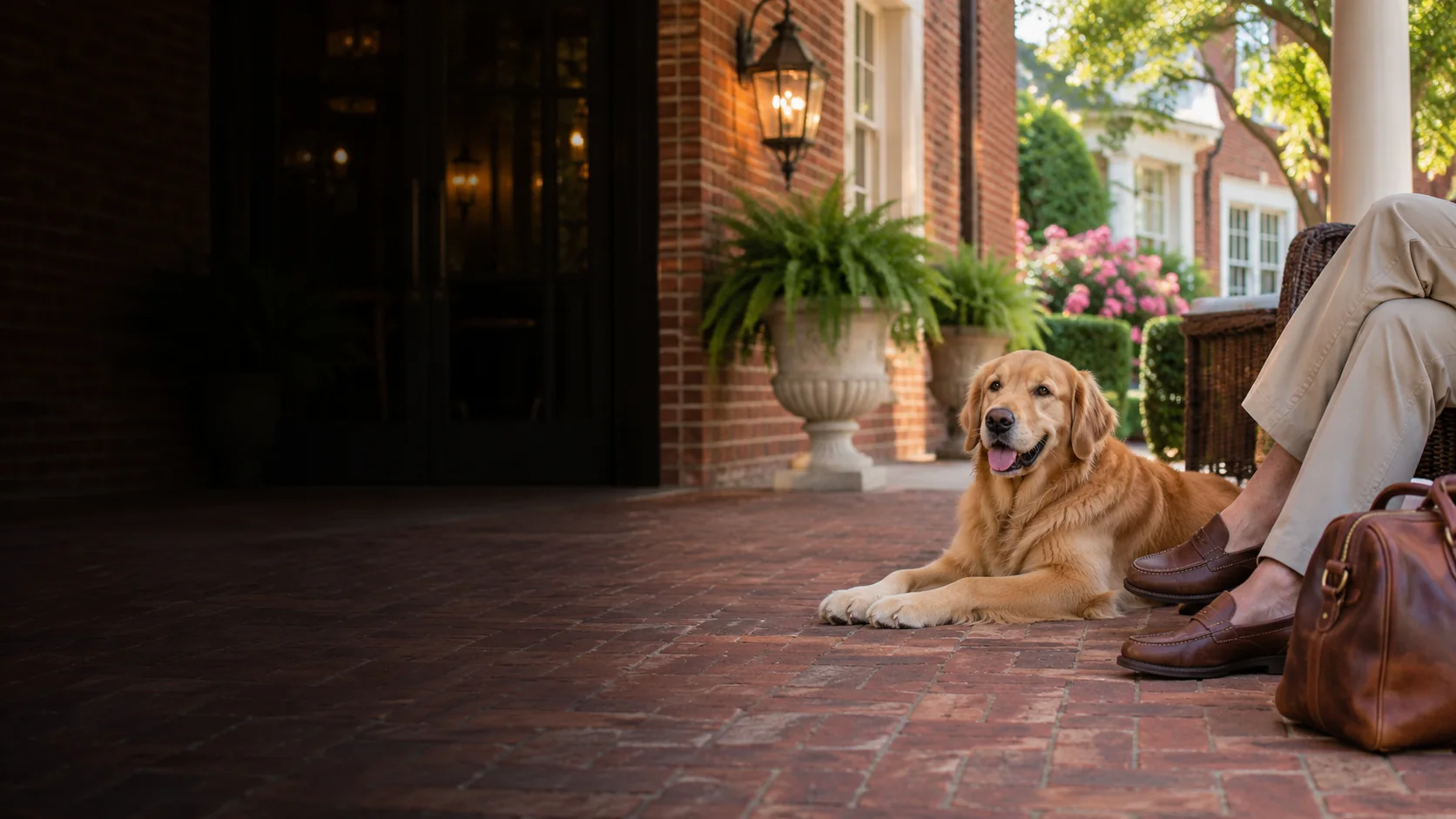
A restaurant meal and a hotel stay create different practical questions for an Alabama service-dog team. At dinner, the issue may be where the dog settles or whether a buffet is accessible. At check-in, it may be a pet deposit, a limited “pet-friendly” room category or plans to leave the dog while visiting an attraction.
The core public-access principles are straightforward, but applying them well means understanding the dog's role, the public areas involved and the handler's responsibilities. An ordinary pet policy is not the complete answer for a qualifying service dog. At the same time, service status does not remove behavior, safety or damage concerns.
American Service Animals has organized this guide around a visit rather than a general housing request. Our existing Alabama ESA-letter guide addresses a different topic; use the Alabama resource hub for broader state information.
Know which animal rules apply to the visit
Alabama's statutory definitions in section 21-7-1 include disability-related trained work and distinguish it from emotional support, comfort or companionship alone. The public-accommodation definition includes hotels and lodging places. These distinctions help explain why a restaurant's pet ban and an apartment's accommodation request are not the same issue.
The DOJ service-animal FAQ gives the federal standard for ADA-covered public places: a dog individually trained to perform work or tasks related to a person's disability. A psychiatric service dog can meet that standard; the fact that a disability is not visible does not make the dog a pet.
When the role is not apparent, staff may ask whether the dog is required because of a disability and what work it has been trained to perform. They may not require medical records, certification or a demonstration. Prepare a truthful task description without suggesting that a vest or registration product establishes the underlying training.
If your animal provides only emotional support, check the restaurant's or hotel's pet arrangements instead of assuming ADA service-dog access. A clinical ESA letter does not change the animal's actual role. If a dog is still in training, Alabama's additional training provisions and identification conditions require their own review rather than an assumption that all completed-service rules apply without qualification.
Plan the meal around access and a safe settling space
The DOJ service-animal requirements explain that food establishments generally must allow service animals in public areas even when ordinary animal-health rules prohibit pets. The relevant area is where customers are permitted, not an invitation to take a dog into a commercial kitchen or other staff-only workspace.
Ask for a table arrangement that works for the group and the dog without blocking a passage. The animal should remain under control and out of the path of servers and other diners. A practical seating request is different from accepting isolation simply because a business prefers not to have a service animal near other guests.
The DOJ FAQ states that service animals may accompany handlers through self-service food lines. It also explains that businesses are not required to seat dogs on chairs or allow them to be fed at the table. Plan how you will move through a buffet or order at a counter while maintaining the dog's position.
Bring the supplies needed for the dog's care rather than expecting restaurant staff to provide them. Arrange a relief opportunity before a long meal and consider how the dog handles the environment. A crowded dining room full of dropped food is a demanding place for an animal that has not developed the necessary skills.
If an employee cites a health-code rule, clarify that the dog is a qualifying service animal and ask whether a manager can review the applicable public-area guidance. Keep the conversation focused on the actual setting. An argument about access does not benefit from unrelated housing or airline forms.
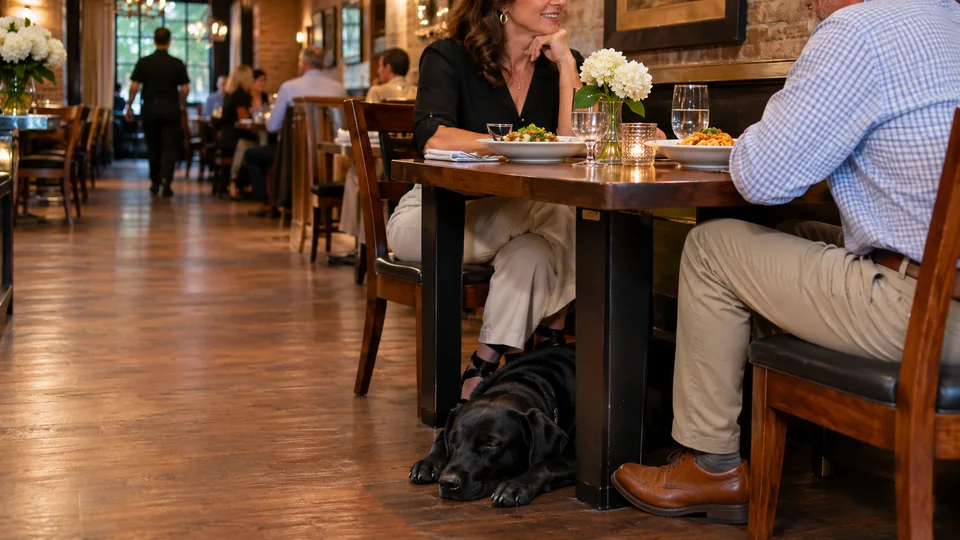 A workable table arrangement keeps the dog with the handler and the route clear.
Reserve the room you need without confusing pet inventory
The DOJ FAQ says hotel guests with service animals must have the same opportunity to reserve an available room as other guests. They cannot be restricted to designated pet-friendly rooms. A booking website's pet filter therefore does not define the complete inventory available to a qualifying service-dog handler.
When discussing a reservation, explain any practical accessibility needs directly. You may need a particular room feature, a manageable route to an exit or information about relief space. These requests should be evaluated on their own merits rather than collapsed into “traveling with a pet.”
Keep the booking confirmation and the relevant correspondence. If an employee says the hotel has no pet rooms left, ask whether they are addressing ordinary pets or a service dog. A manager may be able to correct a category error before arrival, saving a difficult discussion at the front desk.
Do not assume that every short-term rental has the same legal classification as a conventional hotel. Ownership, the type of property and applicable law can affect the analysis. If a listing presents an unusual arrangement or the owner disputes coverage, obtain advice about the actual property rather than relying on a generic hotel answer.
For an ordinary hotel stay, plan the dog's routine along with your own. Check the route from room to exit, how housekeeping requests will be handled and where supplies will be stored. Staff should not be expected to supervise the animal while cleaning or to provide its daily care.
Review fees, cleaning and damage as separate categories
A service-animal surcharge is different from an ordinary charge imposed on all guests. Alabama's service-animal access legislation, including the enrolled law revising chapter 21-7, prohibits an extra service-animal charge in the covered public-access circumstances. Federal ADA guidance likewise distinguishes service animals from pets for deposits and fees.
The DOJ specifically says hotels may not charge for cleaning hair or dander shed by a service animal. Actual damage can be charged under the same damage policy used for other guests. A blanket “deep cleaning” amount added simply because a service dog stayed is not the same as an itemized claim for a damaged door or carpet.
Review the confirmation and final bill. If a pet fee appears automatically, ask management to identify its basis and correct the category if appropriate. Keep the response and receipt. Do not simply ignore a disputed bill; make the question clear and seek advice if it remains unresolved.
It is reasonable to document the room's condition when you arrive and leave, especially if you notice pre-existing damage. Keep photographs factual and focused on the relevant condition. A careful record can resolve a mistaken charge without either side needing to guess what happened.
Responsibility also includes preventing avoidable problems: maintain control, manage cleanup and address behavior promptly. Service-animal access protects participation; it does not make the animal's conduct irrelevant to other people or the property.
Plan outings so the dog remains appropriately supervised
The DOJ FAQ explains that a service animal should not be left alone in a hotel room. The dog must remain under the handler's control, and hotel staff are not responsible for its care. Plan dinner, sightseeing and appointments with that constraint in mind rather than assuming a hotel stay provides a free boarding arrangement.
If an activity is unsuitable for the dog, arrange a responsible alternative in advance. Consider whether a companion can provide care or whether the activity should change. Do not leave the animal unattended because a booking description used the phrase “pet-friendly”; that label does not answer the service-animal supervision question.
A clinical document cannot solve an animal-care problem. American Service Animals provides an individual evaluation pathway for appropriate documentation where service is available. Our PSD-letter guide explains how clinical assessment differs from task training and a venue's access decision.

Find out if an ESA letter is right for you
A few guided questions. Your personal details come last.
If you are unsure whether the dog is an ESA or service dog, review ASA's explanation of animal roles and registration limits before travel. Choose the correct arrangements for the actual animal. Accurate planning protects the handler, the dog and the people sharing the venue more effectively than trying to resolve a mismatch through paperwork at check-in.
Handle a refusal or conduct concern with specific facts
Ask staff to explain the concern. A blanket no-dogs policy, a request for certification, a room-category restriction and repeated uncontrolled barking are different issues. The response should address the actual reason instead of treating every disagreement as identical.
Under ADA guidance, an animal that is not housebroken or is out of control without effective corrective action may be removed. Relevant safety and fundamental-alteration considerations can also apply. Where removal is justified, the person should still have an opportunity to obtain the goods or services without the animal present. Staff do not have to take custody of the dog.
Request a manager if that may resolve a misunderstanding, and offer the relevant official guidance. If the discussion does not lead to a workable outcome, record the business, time, requested service, the dog's conduct and the reason given. Save the reservation, bill or written policy that relates to the problem.
The DOJ complaint process is available for ADA concerns, and qualified local advice can address Alabama-specific questions. A complaint is not an assurance of compensation or a particular finding. A concise, accurate record gives a reviewer a better basis for assessing what occurred.
Alabama restaurant and hotel questions
Can an Alabama restaurant admit a service dog despite a no-pet policy?
ADA-covered restaurants generally must permit qualifying service dogs in public customer areas. That does not include every staff-only location, and the handler must maintain appropriate control. A dog providing emotional comfort alone does not gain the same public-access status from an ESA letter or commercial registration.
Can a hotel limit me to its pet-friendly rooms?
The DOJ says guests with service animals must have the same opportunity to reserve available rooms as other guests and cannot be restricted to pet-friendly rooms. Explain that the reservation concerns a service dog if a booking system or employee applies an ordinary pet-room limit.
May the hotel charge extra for service-dog hair?
Federal guidance says a hotel cannot impose a cleaning fee for hair or dander shed by a service animal. Actual damage is different and may be charged under the hotel's usual damage policy. Ask for an itemized explanation if a bill labels an automatic service-animal charge as cleaning.
Can my dog sit on a restaurant chair?
Service-animal access does not require the restaurant to seat the animal on a chair or allow feeding from the table. Plan a controlled position that keeps the dog with you and leaves circulation space clear. Ask staff about a workable table arrangement without assuming the animal needs a customer seat.
Can I leave the service dog alone in my hotel room?
The DOJ FAQ says service animals should not be left alone in hotel rooms. Arrange your outings and care responsibilities accordingly. Staff are not responsible for watching or walking the dog, and a hotel's pet-friendly description does not replace the handler's obligation to maintain control.
Does an ESA housing letter waive a hotel's pet rules?
A housing-related ESA letter does not automatically create ADA service-dog access at a hotel. Identify whether the animal performs trained disability-related work and which legal framework covers the property. American Service Animals' evaluation process cannot guarantee a venue decision or replace truthful animal classification.
