

PTSD, service dogs and ESAs in Connecticut

PTSD Service Dog, ESA or Both? Connecticut Evaluations for PSD and ESA Letters

Training a PTSD service dog, facing a no-pet lease, or both? In a confidential live session, a Connecticut-licensed clinician evaluates your PTSD and decides whether a psychiatric service dog letter, an ESA housing letter or neither fits. Any letter you receive, whether for a landlord, an HOA or a campus housing office, comes out of that evaluation, since a registry entry carries no legal rights.

PTSD evaluated live
Task dog or ESA
Connecticut signer
Psychology Today Verified
Three steps, one clinician

How Your Connecticut PTSD Evaluation Runs, Start to Finish

Three steps in a fixed order, and a licensed person, not a form, makes the decision.

1Describe your animals and your last two weeks

List your state and city and, for each animal, its name, type, breed, weight and sex. Then come two standard mood questionnaires, the PHQ-9 and GAD-7, covering the past two weeks. Neither one tests for PTSD, and the form asks nothing about trauma, so PTSD itself waits for your live session.

2Pay, then meet your clinician live

Once your plan is paid at checkout, your case goes to a Connecticut-licensed clinician. Every PTSD evaluation centers on a guaranteed live telehealth session with your clinician, on video or by phone, and more than one when your clinician needs it. Being live is the point: the session is included in every evaluation so your clinician knows your medical history before writing anything, which Connecticut's telehealth law expects.

3Receive a signed letter or a plain no

A supported letter, signed by your clinician, appears in your account. If the evaluation does not support one, you hear that directly, and our refund policy then applies.

Start My Free Screening
  • No trauma questions on the form
  • Phone or video, agreed with you
  • A clinician signs or says no

Pricing

Transparent, One-Time Pricing for Connecticut PTSD Letters

Compare the current evaluation fees, read live from our checkout. The screening is free. Your ESA or PSD plan is paid at checkout, and only then does a clinician evaluate you. If you turn out not to qualify, our refund policy returns your money in full when you ask within 30 days of purchase, though a refund is off the table once your letter has been issued and delivered. Questions? Read our FAQ page or contact us.

ESA Housing Letter For One Pet

Clinical review for one emotional support animal and a Connecticut housing letter.

$149.00/ one-time

  • Official ESA letter if supported
  • Licensed professional review
  • Valid for 1 year
  • Digital copy
  • Email support
  • 24-48 Hour
Get ESA Letter
Most Popular

ESA Housing Letter For Multiple Pets

One evaluation covering the support provided by each of your animals in a Connecticut home.

$159.00/ one-time

  • ESA letter for multiple pets
  • All approved pets on one letter
  • Valid for 1 year
  • Digital copy
  • Priority phone and email support
  • Renewal reminders
  • 24-48 Hour
Get Multiple-Pet Letter

PSA Letter

A psychiatric service dog evaluation with a clinician licensed in Connecticut.

$199.00/ one-time

  • Official PSD letter if supported
  • Licensed professional review
  • Valid for 1 year
  • Digital copy
  • Email support
  • 24-48 Hour
Get PSD Letter

Bundle Packages

Compare the combined letter and document options.

Bundle

ESA Letter + Certificate Bundle

An ESA letter and certificate together in one document package.

$199.00/ one-time

  • Official ESA letter if supported
  • ESA certificate
  • Licensed professional review
  • Valid for 1 year
  • Digital copy
  • Email support
  • 24-48 Hour
Get ESA Bundle
Letter + Certificate + ID

PSD Letter + Certificate + ID Card

A PSD letter, certificate and ID card in one package.

$225.00/ one-time

  • Official PSD letter if supported
  • PSD certificate
  • PSD ID card
  • Licensed professional review
  • Valid for 1 year
  • Digital copy
  • Priority email support
  • 24-48 Hour
Get PSD Bundle
Clinical review Secure payment Digital documents One-time plan fee

Need help choosing? Take the free screening first or compare every plan. Documentation depends on clinical approval; optional certificates and cards do not establish access rights.

Why a Signed Connecticut ESA Letter or PSD Letter Matters With PTSD

A letter helps only when a real clinician stands behind it, so each of ours starts with a live evaluation rather than a questionnaire. Here is what that gives you under a no-pet lease or with a trained dog.

A name and a license you can check

Your letter carries the name and signature of the Connecticut-licensed clinician who evaluated you, along with that clinician's license, which you or a landlord can check on the state's lookup.

Built for a no-pet lease

A Connecticut ESA letter is the paperwork behind a written request to keep your emotional support animal where the lease says no pets. It names every animal your clinician approves, more than one when needed, and shows the date it expires.

A PSD letter is a different document

Your psychiatric service dog letter records a clinician's finding that you have a disability and need a dog trained for it. It teaches the dog nothing and proves no training.

Extras that stay extras

No federal or Connecticut registry for ESAs or service dogs exists, and a listing in any registry confers no legal rights. Some of our bundles add an optional certificate and ID card, which grant no access rights and never replace the clinician's evaluation.

Clinician's signatureConnecticut license numberBoth appear on your letter

PTSD Service Dog Requirements Under the ADA and Connecticut Law

Four requirements apply to a service dog for PTSD, and a certificate is not one of them: it is a dog, it is trained for a task linked to your PTSD, it stays under your control, and it is housebroken. Connecticut law borrows the federal definition, and the ADA applies in every Connecticut town as well.

A dog with a PTSD task

Only dogs count, and the training must connect to your disability. The federal definition in 28 CFR 36.104 rules out comfort and emotional support as tasks. Connecticut's Section 22-345 adopts the matching definition in 28 CFR 35.104 and adds dogs in training.

Leash on, unless the task needs it off

Out in public, a leash, harness or tether is the rule under 28 CFR 36.302, with two exceptions: your disability prevents using one, or it would interfere with the task. Then voice, signals or other means keep control. Connecticut adds that the dog stay in your direct custody and control.

Housebroken and settled

The federal rule names two grounds for asking that the dog leave: a loss of control that the handler does not correct, or a dog that is not housebroken. One bark, or barking someone provoked, does not put a dog out of control, the Justice Department says.

Licensed like any dog

Service dogs follow local licensing and vaccination rules. Connecticut licenses dogs from six months of age, renewing by June 30 each year on a rabies certificate, and a trained service dog's license carries no fee when its handler has a disability.

Can PTSD Qualify You for a Service Dog or an ESA? What a Clinician Looks At

Yes, PTSD can qualify you for either one, but no diagnosis qualifies on its own. In your live session a Connecticut clinician listens for three things, and all three have to line up before any letter is written.

A beagle puppy standing with its front paws on a table beside an open laptop, a glass cabinet of ornaments behind it
Photo: Slyronit, CC BY-SA 4.0
  1. Does the picture fit PTSD?

    The American Psychiatric Association groups PTSD symptoms four ways: intrusive memories, nightmares or flashbacks; avoiding reminders; changes in thinking and mood; and feeling keyed up or on guard, such as startling easily or sleeping badly. Symptoms have to persist beyond a month, with real distress or trouble getting through daily life, before PTSD can be diagnosed. The National Institute of Mental Health points out that most people recover from their first reactions to a traumatic event.

  2. Does it limit your life?

    For housing, the Fair Housing Act asks whether an impairment substantially limits a major life activity. For public places, the ADA rules expect an individual look at PTSD to find, in virtually all cases, that it substantially limits brain function, and PTSD that flares and fades still counts if it would substantially limit you when active. In Connecticut, Section 46a-51(20) defines mental disability through the DSM, where PTSD sits among the trauma- and stressor-related disorders.

  3. What is the animal for?

    For an ESA letter, your clinician looks for a link between PTSD and a need in your home. For a PSD letter, the question is a specific task the dog does, or is learning to do, for your PTSD.

Your clinician decides, and the answer can be no. A plan pays for an honest evaluation, and a letter exists only if your clinician backs it.

What a Service Dog for PTSD Is Trained to Do, in the Justice Department's Words

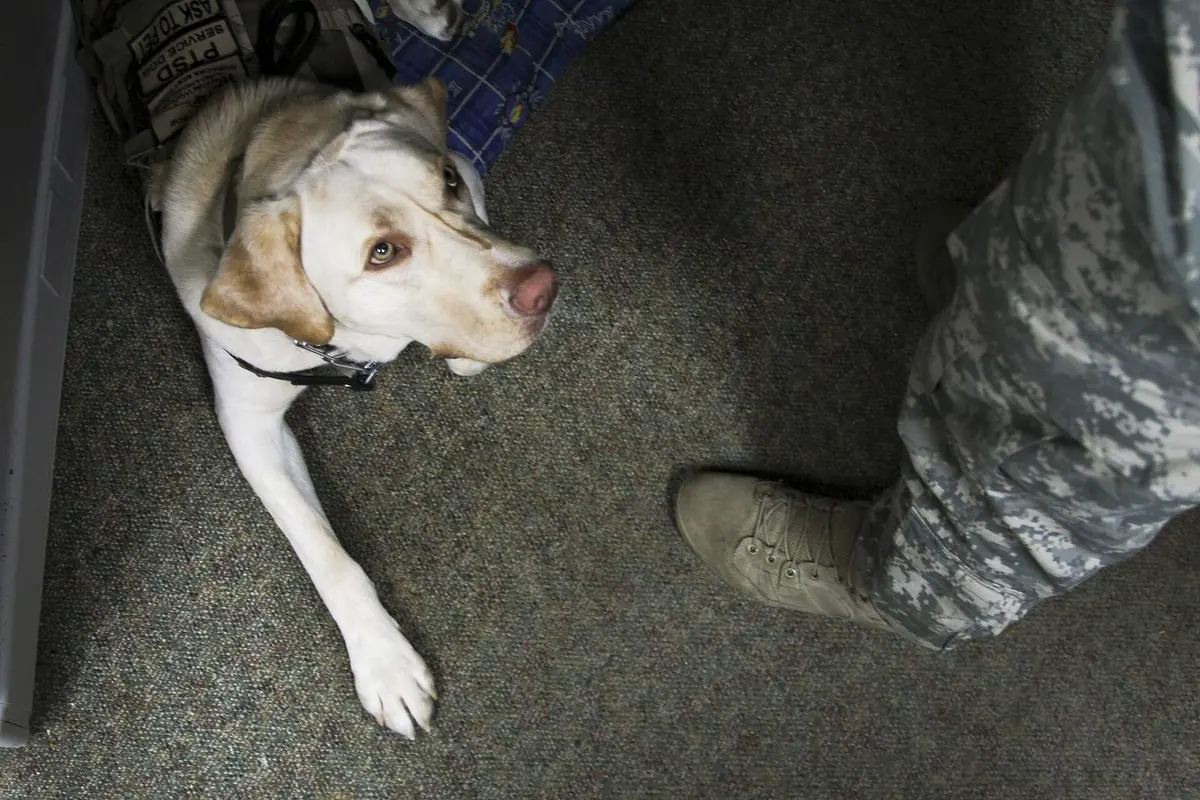
A psychiatric service dog takes a specific, trained action when PTSD symptoms call for it. These five come from the U.S. Department of Justice itself; your dog's task should be one your clinician can tie to how PTSD affects you.

A PTSD service dog lying on an office carpet beside its handler's boot and camouflage trouser leg
Photo: Sgt. Zach Sheely, Public domain

Clear a room first

The dog goes into a space ahead of you, checks that no threats are there, then comes back and signals that it is safe. DOJ's service animal FAQ says such a dog may work off leash for that job and wear its leash the rest of the time.

Run a safety check

Safety checks and room searches for people with PTSD are named in the Justice Department's 2010 rule guidance as work a psychiatric service dog can be trained for.

Cue the start of an episode

The same guidance describes a dog that nudges or paws you as an episode begins, then leads you out of the setting that set it off.

Settle you in an anxiety attack

Settling someone with PTSD through an anxiety attack is one of the examples of trained work in DOJ's service animal guide.

Interrupt harmful behavior

The federal definition includes preventing or interrupting impulsive or destructive behaviors for people with psychiatric disabilities.

Guarding, deterring, comforting: not tasks

Guard or attack training: DOJ says the work of a PTSD dog would not involve unprovoked aggression. A dog's crime-deterrent effect, and comfort or companionship, are not tasks under the federal rule. That line separates a PSD from an ESA.

Emotional Support Animal for PTSD: What It Can Do Under a Connecticut No-Pet Lease

An emotional support animal for PTSD is a housing accommodation. A Connecticut landlord can be asked to make an exception to a no-pet rule for it, but the animal still cannot claim entry to shops, restaurants or buses.

Emotional support animal · PTSD at home

Inside your front door

Section 46a-64c counts a refused reasonable accommodation as housing discrimination when the change may be necessary for a resident with a disability to use the home on the same footing as anyone else. Asking to keep an ESA for PTSD in a building that bans pets is that kind of request, and the landlord weighs it on its facts. Two owner-occupied setups fall outside Section 46a-64c: rooms rented in a single-family home the owner lives in, and the second unit of a two-family house whose owner occupies the first.

Past the front door

Shops, buses and planes

Section 46a-64 gives entry rights to service animals, not ESAs, and the Justice Department says animals that only comfort are not service animals under the ADA. An airline is free to handle an ESA as a pet: 14 CFR 382.3 limits service animals to trained dogs.

Since May 22, 2026, a HUD enforcement memo presumes that asking for an individually trained animal is reasonable, and gives no such presumption to waiving pet rules for an untrained ESA. That memo did not amend the Fair Housing Act, did not touch private lawsuits and did not alter Section 46a-64c, and we found no statement about it from Connecticut's human rights commission. If your dog is trained for a PTSD task, say so in your request: that is the firmer footing.

Connecticut Law on Psychiatric Service Dogs for PTSD: Shops, Town Clerks, Landlords

Connecticut lets a person with PTSD take a trained psychiatric service dog into shops and restaurants, license it with no fee, and ask a landlord to make room for it. An untrained ESA gets only the housing request.

At a shop, cafe or hotel

Section 46a-64 bars shops, restaurants, hotels and other places open to the public from turning you away for having a service animal with you, or from adding a charge for it, as long as you keep the dog in your direct custody and control. A PTSD dog's job is often not obvious, so staff may put two questions to you: does a disability make the dog necessary, and which specific job was it trained for? Answer with the task, such as "she checks rooms before I go in", never your diagnosis. Under the ADA, staff also may not ask for papers or a demonstration.

A no-fee tag from the town hall

Section 22-345 has the town clerk issue a license and tag at no fee to an owner or keeper with a disability, mental disabilities counted, for a dog already trained as a service animal, or one still being trained for that role. If that clerk never licensed the dog before and its work is not obvious, the clerk may ask the same two questions. For an ESA dog, the ordinary yearly license applies under Section 22-338.

Asking a landlord for room

Ask in writing, name each animal, and say whether the dog is trained for a PTSD task, since HUD now presumes requests for trained animals reasonable. Section 46a-64c covers a PSD request and an ESA request alike.

Norwich City Hall in Connecticut, a red-brick building with a mansard roof and a white clock tower, seen across its front lawn
Photo: Marc N. Belanger, Public domain

Refused? CHRO, the state's human rights commission, takes complaints filed within 300 days from the date of the refusal, under Section 46a-82(f)(2). A refusal at a shop or restaurant is a public accommodation complaint for the CHRO regional office serving your town: Hartford, Bridgeport, Waterbury or Norwich. Housing refusals have their own desk, the Housing Discrimination Unit in Hartford at (860) 541-3403, and a housing complaint under Section 46a-64c needs no notary.

PTSD Help in Connecticut: Crisis Lines, Trauma Hotlines and Counseling Costs

In a PTSD crisis, 988 answers calls and texts, and 211 with option 1 reaches the state's crisis route; survivors of sexual or domestic violence also have free statewide lines of their own. Nothing on this page replaces care: a letter from us is a document, not a treatment for PTSD.

Numbers to keep

988
Reach a counselor by calling or texting 988, or through the chat at 988lifeline.org, at any hour; it is free and confidential. According to the state mental health agency, DMHAS, Connecticut's 988 Contact Center is run by United Way of Connecticut/211 and can connect you to a mobile crisis team.
211, then 1
The state's suicide and crisis route, from anywhere in Connecticut.
911
Call or text in an emergency.

After sexual violence

The Connecticut Alliance to End Sexual Violence runs a statewide 24-hour toll-free hotline: 1-888-999-5545 in English, 1-888-568-8332 in Spanish. Its nine member centers offer free, confidential counseling and support groups.

After domestic violence

CT Safe Connect answers calls and texts at (888) 774-2900, and chats too, 24/7/365. It is free and confidential, and it links you with a local domestic violence program.

Counseling costs after a crime

The Judicial Branch Victim Compensation Program may help pay certain crime-related costs that insurance does not cover. Emotional injury from a threat of physical injury or death can qualify for up to $5,000 toward medical, dental, counseling and prescription costs. Apply within 3 years of the injury: 1-888-286-7347.

Veterans and service members have their own federal routes, VA Connecticut Healthcare System and the Vet Centers, and our Connecticut veterans page is the place for veterans' questions.

How to Get a Service Dog for PTSD in Connecticut, Step by Step

You need three things: a disability, a dog and task training. A clinician's letter matters mostly for housing, and the town license is free for a service dog whose owner has a disability. Work through it in this order.

  1. Mark 1

    Get evaluated by a clinician first

    An evaluation can put in writing that you live with a disability and that you need a trained dog. Shops may not ask for that letter; it is mainly for housing requests.

  2. Mark 2

    Choose the dog and the training route

    The ADA lets you train the dog yourself, with no professional program required. Pick the task first, from the list above, so the training has a target.

  3. Mark 3

    Train the task and the manners

    The ADA covers a dog in public only once it is trained, so practice control, house manners and the task before you rely on public access.

  4. Mark 4

    Collect the no-fee license early

    Section 22-345 covers a dog in training too, so the free license can come early. Bring the rabies certificate, and renew by June 30 each year.

  5. Mark 5

    Tell your landlord and your airline

    Put your request to your landlord in writing and say the dog is trained. An airline may require the U.S. DOT service animal form under 14 CFR 382.75; our letters are written for landlords, not airlines, so check with the airline before you fly.

Connecticut Help Desks for a Refusal, Harm to a Service Dog or a License Check

Three desks cover most problems a PTSD handler meets here: Disability Rights Connecticut for a refusal, the Victim Compensation Program for harm done to the dog in a crime, and the eLicense lookup for a doubt about who signed a letter.

A door or a lease was refused

Disability Rights Connecticut calls itself Connecticut's P&A, the protection and advocacy group for people with disabilities. Call before any deadline passes, and keep notes on who refused you, where and when.

Hartford office, 75 Charter Oak Ave., Ste 1-101; call (860) 297-4300, or (800) 842-7303 toll-free in Connecticut

Your service dog was hurt in a crime

The Victim Compensation Program lists a person with a disability whose service animal was injured or killed during a crime among those who may apply. The Office of Victim Services runs a statewide helpline as well.

Victim Compensation 1-888-286-7347; helpline (800) 822-8428

You want to check a clinician

Search the name or license number on Connecticut's eLicense lookup, which covers professional counselors, clinical social workers, marital and family therapists, psychologists, physicians and APRNs.

PTSD Questions From Connecticut Handlers, Renters and Families

Can PTSD qualify you for a service dog in Connecticut?

Yes, when two things hold: PTSD is a disability in your life, and the dog has been individually trained for a task linked to it. Connecticut follows the federal service animal definition, so a dog whose presence only comforts you does not qualify. A PSD letter can record a clinician's finding of a disability, but it never takes the place of the training.

Will a Connecticut clinician write an ESA letter for PTSD?

Only if your clinician finds that PTSD substantially limits one of your major life activities and ties the animal to a need in your home. An ESA letter then backs a housing request under Section 46a-64c; the animal still has no right to enter stores or ride buses.

How much does a PTSD service dog cost in Connecticut?

There is no set price, because the cost depends on how the dog is trained, and the ADA lets you train it yourself. Connecticut adds no fee for service dog status, and the town license for a trained service dog is free when its handler has a disability. The PSD plans and their prices are in the pricing section above.

Is a PTSD service dog ever free in Connecticut?

Not as a rule: we know of no Connecticut law that provides free service dogs. What the state does make free is the license and tag for a trained or in-training service dog whose owner or keeper has a disability, under Section 22-345. If you apply to a training program, ask in writing what it costs and what it expects of you before you commit.

Can a Connecticut store ask what my PTSD is?

No. If the dog's work is not apparent, staff get two questions and no more, one about whether you need the dog for a disability and one about the task it is trained for. Your diagnosis, any paperwork and a demonstration of the task are all off limits.

Does a service dog for PTSD need a vest, certificate or registration?

No. Under the ADA a service dog needs no vest, special harness or ID tag and no certification, and no one may require you to register it as a service animal. Connecticut keeps no official registry either. The optional certificate and ID card from our bundles give no access rights.

Can a dog trained to guard me count as a service dog for PTSD?

No. Justice Department guidance says the work of a PTSD dog would not involve unprovoked aggression, and the federal definition says a dog's crime-deterrent effect is not a task. Non-violent trained work does count, for example a room check before you walk in.

Is an ESA for PTSD still protected in Connecticut housing after HUD's 2026 memo?

It can be. Section 46a-64c still requires reasonable accommodations, private Fair Housing Act suits are unaffected, and the memo changed only how HUD enforces. HUD now presumes requests for trained animals reasonable but not pet-rule waivers for untrained ESAs, so a trained task gives firmer footing. We found no CHRO statement on the memo.

Do I need a PTSD diagnosis before my evaluation?

No. You can start the free screening without one, and your clinician evaluates you. Bring any earlier diagnosis, your therapist's name and your treatment history: under Connecticut's telehealth law, a clinician must know your medical history or have access to it.

Can my PTSD dog fly with me?

Usually, if it is a trained service dog. An airline may ask for the U.S. DOT service animal form under 14 CFR 382.75, and it may treat an ESA as a pet. Our letters are housing documents, so confirm with the airline what it requires before you book.

Other Connecticut Pages for People Living With PTSD

This page was written for Connecticut residents with PTSD and the people close to them, and it is current as of November 2026. Treat it as general information, not legal advice and also not medical advice; no letter or animal treats PTSD. Rules set by landlords, town clerks, businesses and airlines can differ, so check with them directly. The hotlines, agencies and legal offices named here are not affiliated with American Service Animals. Screening does not guarantee a letter, and your clinician decides. Unsafe right now? Call or text 988.

PTSD and a No-Pet Lease? Talk It Through With a Clinician

Start with the free screening, and after checkout a Connecticut-licensed clinician will meet you live by video or phone. You will hear plainly which letter, if any, fits your PTSD.

Free mood screen
Video or call
A real person decides
AI Assistant Online
Hi! I'm your AI assistant for American Service Animals. I can help you with:

• Questions about ESA & PSD letters
• Understanding the evaluation process
• U.S. housing laws & regulations
• Pricing and payment options

How can I help you today?